.png)

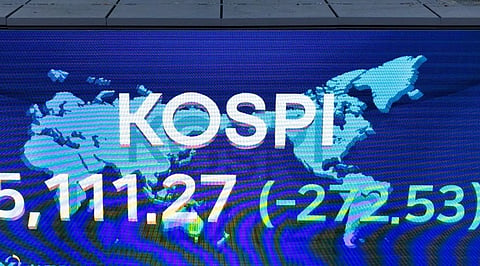
South Korea’s stock market has lost nearly half its value in five months as concerns about artificial intelligence investment returns weigh on semiconductor stocks. The Kospi fell to an intraday low of 4,586.80 points on Monday, retreating sharply from its record closing level of 9,114.55 on June 22.
The benchmark rebounded 6.32% on Tuesday following Nvidia CEO Jensen Huang’s return, reclaiming the 5,000 mark. However, renewed selling pushed the index back into the 4,700 range on Wednesday morning.
South Korea’s equity market has experienced three major periods of selling since June. Initial concerns about AI profitability and rising interest rates triggered the first downturn between late June and July.
Selling resumed in October as investors questioned the revenue growth prospects of AI companies. Regulatory uncertainty, credit risks and changes in Nvidia’s leadership intensified market pressure in November.
“The recurring issue was the sustainability of AI investment, with semiconductor concentration and foreign selling amplifying the declines,” said Lee Kyoung-min, head of research at Daishin Securities.
Meanwhile, financing arrangements supporting AI infrastructure expansion have attracted greater scrutiny. Nvidia has invested in some customers and guaranteed portions of their financing, raising questions about their ability to fund future growth independently.
CoreWeave, an AI cloud provider backed by Nvidia, saw its bond yields exceed 15% in October. Investors grew concerned about the company’s reliance on debt to finance data center expansion.
For South Korean semiconductor manufacturers, slower spending on AI infrastructure could threaten the earnings growth that analysts currently anticipate.
Although AI-related selling has affected global equity markets, South Korea has experienced steeper losses. By Friday, the Kospi had declined approximately 47% from its peak, compared with 18% for the Nasdaq and 12% for the S&P 500.
Samsung Electronics and SK hynix accounted for nearly half of the Kospi’s market capitalization on Friday. Their combined share reached 59% at its peak and remains roughly twice the level recorded in June last year.
Industry estimates attribute nearly 70% of the Kospi’s market capitalization losses to the two semiconductor companies.
Foreign investors have also sold more than 220 trillion won (USD 164 billion) worth of Kospi-listed shares this year.
Mirae Asset Securities strategist Yoo Myoung-gan attributed the initial withdrawals largely to profit-taking and portfolio adjustments. More recently, persistent volatility has kept foreign investors selling despite historically low valuations.
The VKOSPI volatility index averaged 59 through early November, nearly three times its average over the previous two decades. Meanwhile, the average correlation between Kospi 200 constituent stock returns climbed from a historical level of 0.2 to 0.67 in October.
“The rise in stock price correlation and concentration in Korea's market contributed significantly,” Yoo said.
Read More: Solana Exits Beta, Backs CoinGecko as Anthropic Shares Debut
Corporate earnings expectations have improved despite the market downturn. Between its June peak and Friday, the Kospi lost nearly 47%, while its projected earnings per share over the next 12 months increased 35.7%.
The index’s forward price-to-earnings ratio declined to slightly above three. That figure represents approximately half the lowest valuation it reached during the 2008 global financial crisis.
Analysts attribute the disparity to uncertainty surrounding semiconductor manufacturers’ ability to maintain profitability beyond the current industry expansion.
“During an upcycle, chipmakers cannot prove they will keep earning well when the cycle slows,” Lee said.
The downturn has also spread beyond semiconductor companies. According to Hana Securities, 81% of Kospi 200 constituents have fallen at least 40% from their respective highs.
Hana Securities strategist Lee Jae-man expects fluctuations in Samsung Electronics and SK hynix shares to continue influencing broader market volatility.
“A rebound from such steep losses will require a catalyst,” the strategist said.
South Korea’s stock market has suffered substantial losses as uncertainty over AI profitability, semiconductor concentration and foreign capital withdrawals pressure equities. Despite improving corporate earnings forecasts and historically low valuations, analysts identify sustained chipmaker profitability and declining market volatility as important factors in determining the prospects for recovery.