.png)

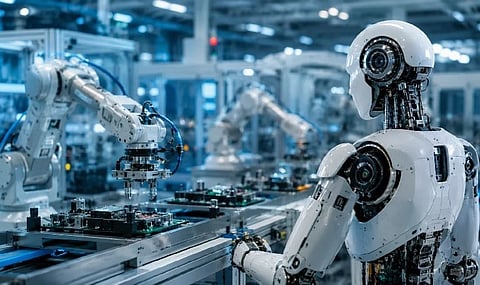
Factories used to depend on workers and fixed machines for most production tasks. Smart robots now inspect products, move materials, spot defects, and help factory teams make better calls. This is a major change for manufacturing.
AI lets industrial robots respond to real conditions on the floor instead of just following fixed instructions. From car plants to semiconductor facilities, AI-powered robotics is taking a bigger part in daily operations.
Global demand for industrial robots keeps climbing. According to the International Federation of Robotics (IFR), factories had more than 5 million operational industrial robots in 2025. Over 600,000 new units were installed that year, and the global robot stock grew 9%. The IFR expects annual installations to reach 655,000 in 2026.
China led with 354,000 installations in 2025, or 59% of global deployments. The United States recorded nearly 38,500, up 12%. Japan logged 36,219 and South Korea about 30,000. India installed almost 10,500 robots, a rise of 15%, while Germany came in under 25,000, down 8%.
Manufacturers in the major economies clearly lean more on robots for routine factory work. The numbers also show strong demand for machines that can handle precise tasks at a steady pace.
Humanoid robots are drawing serious interest from automotive and electronics companies. Boston Dynamics and Hyundai have taken a practical step with the Robotics Metaplant Application Center in Georgia, USA. The center opened in September 2026 and gives Atlas robots a real factory setting to train in. Early tasks include parts logistics, component handling and material preparation.
Hexagon Robotics and Schaeffler have also moved ahead with the AEON humanoid robot. Their programme follows a Train, Validate and Deploy model, with plans for at least 1,000 AEON units across Schaeffler factories in the coming years. The aim is to test humanoids on tasks that need more movement and flexibility than fixed robot arms can manage.
Practical limits remain. Humanoid robots need lower costs, better dexterity and reliable control before they can take on a wide range of factory jobs.
Also Read - Top 10 Industrial Robotics Companies Leading Automation in 2026
AI-powered machine vision helps robots catch defects that human inspectors might miss. Cameras and AI software can check surfaces, measure parts and find missing components at high speed. Quality problems get caught early, and waste goes down.
Autonomous mobile robots, or AMRs, handle another big job. They carry parts, tools and raw materials across factory floors without fixed tracks, and they can change route when a worker or a piece of equipment blocks the way. Predictive maintenance systems add to this by picking up early signs of machine failure from heat, vibration and pressure data.
Digital twins are another useful tool. A digital twin is a virtual model of a real machine or factory process, so engineers can test changes there before touching the actual production line.
Major Manufacturers Expand AI Factory Plans
In March 2026, Samsung Electronics announced a plan to turn all its manufacturing operations into AI-driven factories by 2030. The plan spans material supply, production, quality checks and product shipment, and is meant to give factory teams tighter control over the whole process.
Semiconductors offer a clear example. Boston Dynamics and GlobalFoundries expanded their partnership in November 2026 to use Spot inspection robots at semiconductor facilities across the United States, Europe and Asia. Spot has completed more than 90,000 inspections in Singapore since April 2026, with a reported mission success rate of 99%. GlobalFoundries also plans to test the Atlas humanoid at its facilities from early 2027.
In shipbuilding, HII signed production agreements with Path Robotics and GrayMatter Robotics. The programme could cover up to USD 900 million of shipbuilding work over seven years, subject to performance and readiness milestones, with a focus on complex fabrication and assembly.
India Gains Ground in Factory Automation
India has become an important market for industrial robotics. Its 2025 total of almost 10,500 units was a 15% rise on the year before. According to the IFR, the country ranked sixth in annual robot installations, and installations grew at an average annual rate of 27% from 2020 to 2025.
Automotive plants remain a major source of demand, with electronics, pharmaceuticals, machinery and warehousing offering strong openings too. Car makers use robots for welding, painting and assembly. Electronics firms need precise inspection and part handling, and drug makers can use automation for packaging and product checks.
India could also build a bigger role in robot design, software, machine vision and factory automation services. Local skills and lower system costs will matter a lot to that progress.
Robots can raise output, product quality and worker safety, but factory upgrades need careful planning. New machines, sensors, software and expert support all add cost. Older equipment may lack the systems modern AI tools depend on. Cybersecurity is another worry as more factory machines connect to digital networks.
A shortage of trained technicians can slow projects too. Manufacturers need staff who can set up robots, check AI results, repair equipment and manage safe human-robot work. The sensible approach is to start with tasks that have clear value, such as defect checks or material transport, and expand once real gains show up.
Why this Matters
AI-powered robotics will shape the future of manufacturing. It helps factories improve quality, cut waste, lower operating costs and keep workers away from dangerous tasks. As global competition grows, companies that adopt smart automation can make goods faster, respond to market needs and strengthen their position in the sector.
AI-powered robotics now gives manufacturers more than faster machines. It offers factory teams better ways to control quality, reduce equipment failures and handle complex production tasks. The IFR expects annual robot installations to reach 806,000 by 2029, which points to continued growth.
Still, the strongest results will come from careful choices, not robot counts alone. Factories that match the right technology to the right task can gain a clear edge in cost, quality and reliability. The real test is how well people, machines and AI work together on the factory floor.
1. How does AI transform manufacturing?
AI helps factories improve production, detect product defects, predict machine failures, manage materials, and make better decisions through data analysis.
2. What are AI-powered industrial robots?
These are robots that use artificial intelligence, sensors, and cameras to understand factory conditions and perform tasks with greater flexibility and accuracy.
3. What role do humanoid robots play in manufacturing?
Humanoid robots can handle materials, move components, and perform selected factory tasks in work areas designed for human employees.
4. Which countries lead industrial robot adoption?
China leads the global market, followed by major industrial users such as the United States, Japan, South Korea, Germany, and India.
5. What is the future of AI-powered manufacturing in India?
India has strong opportunities in automotive, electronics, pharmaceuticals, and industrial machinery, with rising demand for robotics, machine vision, and smart factory systems