.png)

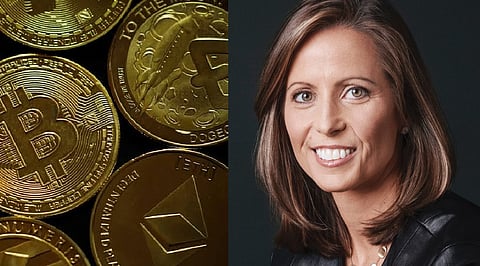
NASDAQ CEO Adena Friedman recently spoke at the TOKEN2049 conference in Singapore. She said that tokenization could unlock tens of billions of dollars tied up as collateral across the global financial system, potentially making markets more efficient and liquid.
Speaking to CNBC’s Joanna Ossinger, Friedman explained how tokenizing assets such as US Treasuries, equities, and market funds could make collateral easier to transfer and use.
Tokenization involves representing financial assets, including stocks and bonds, as digital tokens that can be transferred using blockchain technology.
“If you tokenize all those instruments along with the flow of money, then the collateral becomes very fluid,” Friedman remarked.
She noted that institutional interest in tokenization increased over the past year, partly after the US passed the Genius Act, which established a regulatory framework for stablecoins.
“If we can tokenize money, then we can tokenize the flow of capital,” she further added.
Friedman also highlighted that institutional interest is converging with retail investors’ demand for round-the-clock trading. According to her, the retail ecosystem has been ‘about 10 years ahead’ in seeking such access.
Also Read: US Stock Market: Dow, S&P 500 and NASDAQ Futures Fall as Oil Prices Jump Nearly 5%
Moving financial markets to a 24-hour, seven-day-a-week model would require significant industry-wide changes. Friedman said exchange infrastructure would be the easiest part of the transition.
Financial institutions traditionally use market closures to update systems and manage risks. Continuous trading would require risk management and collateral processes to operate without interruption.
“Everything has to be real time all the time,” she noted.
Artificial intelligence could help financial institutions manage this shift. NASDAQ has launched digital agents within its risk management platform that initially provide recommendations. Banks could eventually use these agents to act more directly.
“AI is critical for 24/7,” Friedman said.
Arjun Sethi, co-CEO of cryptocurrency exchange Kraken, told CNBC that companies outside the US are exploring tokenization and greater access to American capital markets.
Sethi cited a company generating roughly USD 25 million in revenue that was considering ways to access capital markets. He also pointed to larger international companies interested in tokenization and US public listings.
However, Friedman cautioned that continuous trading may not suit every asset.
“Not every asset is liquid enough to support a 24/7 environment,” she added.
The NASDAQ CEO said that stronger connectivity across the global financial system could expand access to asset classes that have previously remained out of reach for some investors.
