.png)

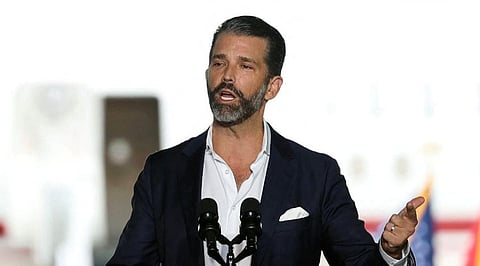
Kalshi has ended its advisory contract with Donald Trump Jr. after his venture capital firm, 1789 Capital, increased its financial commitment to rival prediction market Polymarket. The decision follows a planned USD 300 million investment that could bring the firm's total commitments to around USD 500 million. Trump Jr. had served as an adviser to both platforms after joining their respective boards in 2025.
Neither Polymarket nor Trump Jr. immediately responded to Reuters' requests for comment. The departure comes as both companies expand their businesses while facing legal disputes over prediction market regulation.
1789 Capital agreed in September to contribute approximately USD 300 million toward Polymarket's planned USD 1 billion funding round. The financing valued Polymarket at USD 21 billion, compared with nearly USD 15 billion before the proposed transaction.
An investment firm spokesperson confirmed those financing details at the time. The new contribution would follow an earlier investment of roughly USD 200 million, bringing combined commitments to approximately USD 500 million. The reported figures did not establish a final ownership percentage.
Trump Jr. joined Polymarket's advisory board in August 2025 after 1789 Capital made its initial investment. His involvement with Kalshi began months earlier, when the company appointed him strategic adviser in January 2025.
Kalshi CEO Tarek Mansour initially described the appointment as a way to support market strategy, business growth, partnerships and audience expansion. Trump Jr. also said his family used Kalshi during the 2024 presidential election.
According to Reuters, the Financial Times reported that Trump Jr. received a stake worth USD 300,000 when he joined Kalshi. The latest departure report did not explain what would happen to that equity.
The advisory split comes amid disputes over how authorities should regulate prediction markets. Kalshi maintains that federal regulators oversee event contracts on registered exchanges. Meanwhile, several state authorities argue that certain contracts amount to unlicensed gambling.
A Minnesota federal court addressed one such dispute on July 27. U.S. District Judge Katherine Menendez granted preliminary relief to the federal government, CFTC, Kalshi and Polymarket US.
The injunction prevented Minnesota from enforcing its new prediction market statute against CFTC-registered exchanges while litigation continued. The court found that the plaintiffs had a strong likelihood of succeeding on part of their federal law argument.
Minnesota had planned to introduce the statute on August 1. It carried criminal penalties for covered prediction market operations and related activities. The exchanges also challenged advertising restrictions and limits involving information from third parties.
The broader legal dispute raises a central question: Which authorities have the power to regulate event contracts offered through federally registered exchanges?
The court's preliminary decision did not settle that question permanently. Further proceedings will address the remaining legal issues.
Read More: Coinbase, Kalshi Lead Six Firms Backing CFTC in Stock Perpetual Futures Lawsuit
Alongside those court battles, the CFTC has examined potential manipulation involving prediction market contracts. On September 22, the agency issued guidance concerning contracts tied to statements, appearances and interactions by named individuals.
The regulator warned that such contracts could create heightened manipulation risks. Their outcomes may depend on individual conduct, while independent verification can prove difficult.
Under Core Principle 3 of the Commodity Exchange Act, exchanges must assess whether contracts are readily susceptible to manipulation. The agency also outlined conditions under which certain mention contracts could meet existing requirements.
Separately, the CFTC settled charges against former White House teleprompter operator Gabriel Perez on August 28. Investigators found that Perez used advance access to presidential speeches to trade mention contracts between December 2025 and February 2026.
The settlement required Perez to return USD 107,539.02 in trading profits and pay a USD 65,000 civil penalty. He also received a three-year trading ban.
The CFTC credited KalshiEX for assisting the investigation. It also said Perez received a substantial penalty reduction because he cooperated with investigators.
Kalshi's decision to end Donald Trump Jr.'s advisory contract follows 1789 Capital's growing financial commitment to Polymarket. The firm's combined investment commitments could reach USD 500 million. Meanwhile, both prediction market platforms continue navigating legal challenges as the CFTC examines trading risks and manipulation concerns across event contracts.