.png)

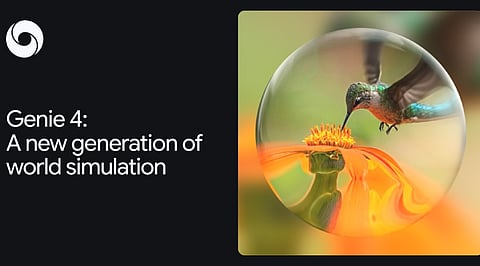
Google DeepMind has announced Genie 4, a new world model that generates interactive environments for real-time simulation. The model lets users explore virtual worlds, control camera movements, and modify scenes with natural-language prompts, with changes reflected as the simulation evolves.
Genie 4 combines capabilities from Google's Gemini family to improve the appearance, behavior, and continuity of simulated environments. DeepMind sees world simulation as an important step towards artificial general intelligence (AGI), with potential applications in robotics, filmmaking, journalism, gaming, and manufacturing.
Genie 4 supports four key capabilities. Real-time scene control allows users to change weather, move cameras, and introduce people or objects through text prompts. Gemini adapts instructions to the surrounding environment and helps maintain continuity between user inputs.
The model also simulates physical scenarios involving aerodynamics, collisions, and other interactions. It can generate people who move naturally, respond to their surroundings, and be controlled interactively in real time.
Genie 4 is Google's first real-time world model to generate audio natively. It can produce environmental sounds, including wind in trees and waves at a beach, alongside music and interactive dialogue. Characters can converse and respond to user inputs or events within simulated environments.
For complex scenarios, Gemini 3.8 Flash acts as a guiding agent alongside Genie 4. It observes scenes, breaks goals into steps, and checks incoming frames to assess progress. When conditions change, or users intervene, it adjusts its plan to support simulations involving causality, procedural behavior, and multi-step reasoning.
Google DeepMind is also exploring Genie 4 with Gemini 4 Argon as part of Gemini Robotics, allowing tasks to be broken into steps and rendered in simulations.
Google DeepMind is working with trusted testers in creative industries, journalism, education, gaming, and engineering. Filmmakers are exploring the model for pre-visualization, while photojournalists are testing ways to turn archival photographs into simulated environments.
Game developers are experimenting with interactive prototypes, visual styles and mechanics through prompts before writing engine code. Enterprise partners are also evaluating the model for industrial simulations and robotics research.
Also Read: Google DeepMind Launches Gemma 4 12B to Bring Cloud-Level AI to Local PCs
All generated video and audio will include SynthID, Google's imperceptible digital watermarking technology. Genie 4 remains an early-stage research model, and visual details and object permanence can drift during longer sessions or after complex prompt edits.
Other challenges include complex physical interactions, real-time audio accuracy, readable text, spatial accuracy, and long-term consistency.
Google DeepMind is rolling out Genie 4 as a research preview to a limited group of trusted testers. It is coming soon to Google AI Ultra subscribers through Project Genie and to early-access partners through the Gemini API and Google AI Studio. Users can also join the Genie 4 waitlist through Project Genie.
