.png)
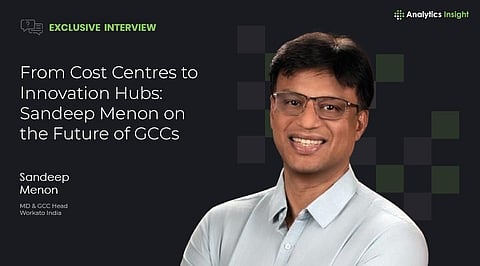
From Cost Centres to Innovation Hubs: Workato India’s Sandeep Menon on the Future of GCCs

Sandeep Menon, Managing Director & GCC Head of Workato India, shares his perspective on the evolution of India’s GCC ecosystem from delivery centres into strategic hubs for innovation, AI engineering, and global leadership. He discusses AI-led automation, the growing talent base in Tier 2 and Tier 3 cities, the demand for AI Architect-level skills, and Workato’s efforts to develop India’s AI ecosystem through university partnerships and developer communities.
How do you see India’s GCC landscape evolving from traditional delivery centres into strategic hubs for product innovation, AI engineering, and enterprise leadership? What are the key characteristics that distinguish the next generation of high-impact GCCs?
I think this evolution was pre-destined the day Global players transitioned from outsourced centres to GCCs. Having been on the IT services side as well, I have always said that global players may come for the cost, but they will only stay for the capability. What happened with GCCs is that the skill ecosystem and capability got showcased directly to the principals and they have been happy to take advantage of the same. Despite a bit of initial scepticism, everyone has come to realise that India is no longer just about cost. It’s about the ability to deliver skills at a scale that is needed for today’s rapid pace of development. Specialist skills are available in multiple places, but the ability to deliver it at scale remains India’s forte.
AI is fundamentally reshaping how organisations operate. How is AI influencing GCC operating models, organisational structures, and talent strategies, and what changes do you believe GCC leaders need to make to remain competitive?
Clearly AI led automation & orchestration of multiple business processes is the only way forward for GCCs, if we want to retain our competitive advantage. I would suggest to GCC heads who are very operational efficiency focused, to take a step back and also think strategically. Yes, it may still be cheaper today to get things done manually in some cases. But that’s not the point. The learning and experiential advantages of being a first mover in AI led automation, will give them sustainable advantages way into the future.
India’s talent ecosystem is expanding beyond the major metropolitan cities. What role do Tier 2 and Tier 3 cities play in Workato’s talent strategy, and how can GCCs create greater access to skilled professionals across these emerging talent hubs?
Workato hires for top talent, irrespective of where they come from. Having said that, we do find that a large part of our workforce today comes from Tier 2 & 3 cities. And this experience is consistent across companies. A lot of the technical talent is now coming from smaller towns and cities. They are diligent and technically strong. And very open to being further trained.
Which begs the question, why don’t GCCs then just go to those cities and set up hubs? The answer to this question is a little more nuanced. I have been part of government panels in smaller states for advising their policies, and the problem I often see is that just building a flagship “IT park” does not really solve the problem. Policy makers need to take a hard look at creating the ecosystem that is needed for tech talent to stay, because they are highly mobile. Good international school education, medical facilities, public services, entertainment & nightlife, everything matters to this workforce. They and their families have a life outside the IT park, that also needs to be vibrant. Without modernising the city infrastructure and culture thoroughly, the IT park is never going to help. And even if GCCs do set up shop there, there will be a continuous exodus of employees, moving to urban centers. This is the challenge that we need to jointly solve.
As GCCs take on increasingly complex global mandates, how is Workato building leadership depth and specialised AI capabilities in India to support evolving business priorities? What skills and leadership qualities will define the GCC workforce of the future?
Workato is in the unique position of also being a product company in the AI solutions space. So we place a premium on eating our own cooking. All our processes are continuously being evaluated for AI led automation. We make liberal use of AI Genies and chatbots. All our staff are AI trained and provided with enterprise access to AI tools. Apart from this, Hyderabad hosts one of the key units in our global chain of “AI labs and research centres”. In fact, the Workato AI Hub based in Hyderabad works on the frontlines of gathering real world customer requirements from AI solutions and constantly weaves the same into our product development process. It remains our fastest growing unit, but availability of AI Architect level skills continues to be a challenge across the globe today. What we see now is that attracting that talent is not just a question of pay, but also how much of a technical edge the company provides and how close to the AI product development space it operates in. Luckily for us, we tick all boxes and find it relatively easier to find the right talent.
Workato has been investing in India’s broader AI ecosystem through university collaborations, talent development initiatives, and a community of more than 11,000 members. What is your vision for these initiatives, and how can industry-academia collaboration help strengthen India’s position as a global AI and innovation hub?
We have always believed that leading edge technologies require the corporate ecosystem to interface directly with academia. Given the rigorous nature of curricula development, there will always be a little bit of a lag before academia gets onto the latest technology waves. But when companies that can see the requirements coming interface with academia and help set up labs, early training, certifications etc., it helps reduce that lag significantly. It’s a win-win scenario for both parties. This is why we work with a focused set of high level universities and support them with not just content and direction, but also practical exercises, training and certification.
The same holds good for developer communities. The more we help them learn, the better the quality of manpower that our customers and partners get. And in this era of rapid development, one can’t ever risk arriving in the market with a great product that not enough people know how to use, or implement. That is why we have a strong programme with city chapters, city ambassadors etc. We spend a lot of our time on real world customer problems, how to solve for them, beta access to the latest tools etc.
Workato continues to see both these as areas of strategic importance, and will continue to invest into the same.
