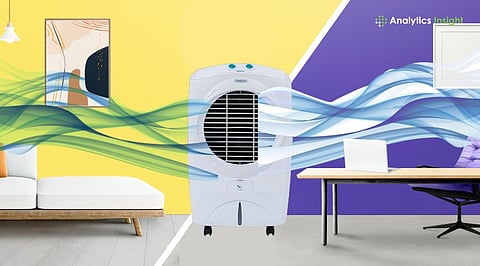
.png)

High-capacity desert air coolers dominate extreme heat markets, offering strong airflow, large tanks, and better cooling performance than compact or tower models.
Airflow (CMH), ventilation, and cooling pad quality matter more than tank size alone when evaluating performance in high-temperature regions.
Energy efficiency, inverter compatibility, and commercial-grade designs are emerging trends as consumers adapt to longer, harsher summer seasons.
Summer is already here, and we are still undecided about which AC to buy. Well, India’s rising summer temperatures, often crossing 45°C, are pushing consumers toward high-capacity desert air coolers. Unlike compact models, these units prioritise water retention, airflow, and durability under harsh conditions.
This article evaluates 10 air coolers built for extreme heat, detailing their unique selling propositions (USP), core specifications, and ideal use-cases to help households and small businesses make informed purchase decisions.
Air coolers provide an economical solution for areas with extreme heat conditions because they function better than air conditioners in dry climates. The system needs proper airflow, together with proper ventilation and accurate system dimensions, to achieve optimal performance.
So, how do you choose the best air cooler in this rising temperature? Well, you need to cross-check some key features while choosing a good AC. These factors go beyond brand names and focus on tank size, cubic metre per hour (CMH) ratings, and cooling pad efficiency. Given below are recommendations best suited for you.
USP: Balanced performance for large rooms
Specs: 90L tank, high airflow, honeycomb pads
Bajaj DMH is ideal for 200–300 sq ft spaces. This cooler delivers consistent airflow without excessive power consumption. It suits urban homes facing peak heat with moderate ventilation.
USP: Superior air throw for open areas
Specs: 90L tank, high-speed fan, multi-directional airflow
This cooler is designed for halls and semi-open spaces. The cooler performs best where airflow circulation is critical, such as verandas or workshops.
USP: Massive tank for uninterrupted cooling
Specs: 135L capacity, turbo fan, strong air delivery
XForce by Bajaj is suitable for commercial setups or very large rooms. Its large reservoir ensures all-day cooling without frequent refills.
USP: Quiet operation with efficient cooling
Specs: 75L tank, low-noise motor, honeycomb pads
Havel Kace works well in bedrooms and offices where noise control matters, without significantly compromising cooling output.
Also read: AC Buying Guide 2026: How to Choose the Best Air Conditioner for Your Home
USP: Budget-friendly desert cooler
Specs: 65L tank, compact design, decent airflow
This air cooler is best for small to medium rooms with proper ventilation. A practical entry-level option for extreme summer conditions.
USP: Energy-efficient cooling
Specs: 80L tank, i-Pure technology, inverter compatibility
Symphony Maxwind is ideal for users prioritising low electricity consumption, especially in areas with power fluctuations.
USP: High-capacity cooling with durability
Specs: 100L tank, robust body, powerful fan
The Orient cooler is suitable for large households and prolonged summer usage, especially in dry regions.
USP: Commercial-grade airflow
Specs: 100L tank, heavy-duty build, high CMH rating
Novamax Rambo is designed for shops, garages, and industrial spaces requiring strong and continuous cooling.
USP: Affordable performance with modern design
Specs: 85L tank, inverter compatibility, efficient pads
This air cooler is the best mid-range solution for households seeking a balance between aesthetics and cooling efficiency.
USP: Reliable cooling with wide air coverage
Specs: 88L tank, auto-fill, high air delivery
Crompton Ozone is best for consistent cooling in medium to large rooms, especially where water supply access is steady.
Looking ahead, energy efficiency and inverter compatibility have become standard expectations. All thanks to the rising electricity costs. Manufacturers use honeycomb cooling pads together with antimicrobial technologies. The aim is to create products that last longer and maintain better cleanliness.
The growing popularity of commercial-grade coolers for home use represents a significant shift in consumer preferences because of increasing temperatures and expanding residential spaces. Moreover, you should select their product based on room size and usage needs instead of using price as the only factor. The increasing temperatures create a need for purchasing a cooler with high cooling capacity. The purchase should also account for an effective ventilation system.
Also read: Best AI-Powered 1.5 Ton 5-Star ACs in India for Smart Cooling
1. What type of air cooler is best for extreme heat?
Desert air coolers with high airflow and large tanks perform best in extreme heat, especially in dry climates with proper ventilation.
2. Does a bigger tank mean better cooling?
Not necessarily. Cooling depends more on airflow and ventilation, while a larger tank only ensures longer operation without frequent refilling.
3. Can air coolers work in humid regions?
Air coolers are less effective in humid climates because high moisture reduces evaporation, limiting their ability to lower temperatures efficiently indoors.
4. How much temperature drop can I expect from an air cooler?
In ideal dry conditions, air coolers can reduce temperature by 8–12°C, depending on airflow, humidity levels, and room ventilation quality.
5. Are air coolers cheaper to run than air conditioners?
Yes, air coolers consume significantly less electricity than air conditioners, making them cost-effective for long daily usage during peak summer months.
