.png)

Samsung's 2026 Odyssey lineup spans five models, each built around a different approach to gaming performance: more pixels, more speed, or a different display experience altogether
Dual Mode, a feature that lets a panel reduce resolution to unlock a higher refresh rate, ties the entire range together
The G8 family splits into three configurations: pixel density, balanced refresh, and OLED contrast
Samsung's 2026 Odyssey lineup takes a different approach to gaming-monitor performance. Instead of treating resolution, refresh rate, and immersion as competing priorities inside one display, Samsung spreads them across five models. The range runs from a 6K glasses-free 3D monitor to a QHD panel capable of 1,040Hz. It includes the Odyssey 3D (G90XH), three Odyssey G8 variants, and the Odyssey G6. Each one represents a distinct definition of gaming performance.
The 32-inch Odyssey 3D introduces the industry's first 6K glasses-free 3D gaming display. Real-time eye tracking adjusts depth and perspective as the player moves. The result is a layered sense of dimension without a headset. The monitor runs natively at 165Hz. Dual Mode raises that to 330 Hz. Its Fast IPS panel carries a 1 ms GtG response time.
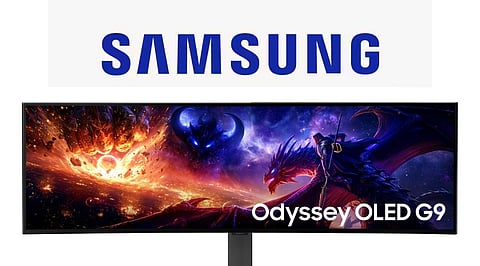
The G8 series expands into three models this year. Together, they reveal Samsung's broader strategy more clearly than any single spec sheet. The G80HS prioritizes pixel density. The G80HF balances resolution with refresh rate. The G80SH trades higher resolution for OLED contrast and 240Hz gaming.
The 32-inch G80HS becomes the first 6K gaming monitor on the market. It runs natively at 165Hz, with Dual Mode reaching 330 Hz at 3K. Built on Fast IPS with 10-bit color, it suits a dual-purpose audience.
Dense native-resolution workspaces work well during the day. An esports-capable panel takes over at night. The G80HS was listed for European pre-order at €1,499 at launch.
The 27-inch G80HF sits one tier below at 5K native resolution and 180Hz. Dual Mode pushes that to 360 Hz at QHD. It suits buyers who want sharper detail than 4K without paying for the G80HS.
The 32-inch G80SH takes the opposite route. Its QD-OLED panel runs 4K at 240Hz, paired with Glare Free coating and VESA DisplayHDR TrueBlack 500 certification. Fast IPS wins on resolution, brightness, and refresh-rate headroom. QD-OLED wins on contrast, black levels, and HDR response.
Samsung reserves OLED for one model in this lineup, not all three. The two panel types solve different problems, and buyers pick the one that matches their priority.
Dual Mode connects nearly every 2026 Odyssey model, and it deserves more attention than a footnote. Switch into Dual Mode, and the monitor reduces its output resolution to unlock a much higher refresh rate. Native mode favors image detail. The lower-resolution mode favors speed.
Neither setting is better in every case. The right choice depends on the game and the hardware running it. Dual Mode does not remove the resolution-versus-speed trade-off. It puts that choice in the player's hands, so one display can cover both roles instead of forcing a decision at the point of purchase.
The 27-inch Odyssey G6 is built for one priority: speed. Native resolution sits at QHD with a 600Hz refresh rate. Dual Mode at HD resolution pushes that to 1,040 Hz, a figure no gaming monitor had reached before this launch.
The ceiling applies only at the lower HD resolution, not at native QHD, and that trade-off matters beyond the spec sheet. At 1,040Hz, the limiting factor often shifts from the monitor to the rest of the gaming system. The GPU and game engine still need to produce very high frame rates to put that speed to use. Response time measures something separate: how quickly individual pixels change state, not how often the panel updates.
Adaptive sync tools such as AMD FreeSync Premium and Nvidia G-Sync Compatible keep the monitor's refresh behavior in step with GPU output, cutting down on tearing.
HDR10+ Gaming adjusts color and contrast scene by scene instead of applying one fixed profile. DisplayPort 2.1 and HDMI 2.1 supply the bandwidth that high-resolution, high-refresh gaming needs.
On the G80HS, UHBR20 support matters for a specific reason: 6K output at high refresh rates places heavy demands on the connection. Older interfaces may not carry enough bandwidth for these resolution and refresh-rate combinations.
Pick the G90XH for glasses-free 3D immersion. Pick the G80HS for 6K workspace density alongside gaming, provided the system can handle the rendering load. Pick the G80HF for 5K detail without giving up high refresh. Pick the G80SH when OLED contrast and 4K/240Hz gaming matters more than maximum resolution. Pick the G60H for competitive play, as long as the system can sustain very high frame rates.
Samsung's 2026 Odyssey lineup makes one point clear: gaming-monitor performance does not have a single definition anymore. The G90XH prioritizes immersive 3D and 6K detail. The G8 family separates resolution, refresh rate, and OLED contrast into different configurations. The G6 pushes competitive speed to 1,040Hz. The result looks less like one flagship monitor and more like a portfolio built around different definitions of performance.
What is Samsung Odyssey Dual Mode?
Dual Mode lets compatible Odyssey monitors reduce output resolution to unlock a much higher refresh rate.
Which Samsung Odyssey monitor has 6K resolution?
The Odyssey 3D G90XH and Odyssey G8 G80HS both offer native 6K resolution at 165Hz.
Is a 1,040Hz gaming monitor better than a 240Hz monitor?
Not always. A 1,040Hz display suits extremely high-frame-rate competitive gaming. A 240Hz QD-OLED monitor like the G80SH can offer stronger contrast and HDR characteristics for other gaming scenarios.
What is the difference between 6K and 4K gaming monitors?
6K provides a higher pixel count and greater workspace density than 4K. 4K can run with less graphics processing power at comparable settings. The practical benefit depends on the GPU, game resolution support, screen size, and desired refresh rate.
Which Samsung Odyssey monitor is best for competitive gaming?
The Odyssey G6 G60H is the most competition-focused model in the lineup, with QHD at 600 Hz and up to 1,040 Hz in HD Dual Mode. Its highest refresh-rate mode suits games and systems capable of producing very high frame rates.
Also Read: Samsung Unveils New Odyssey Gaming Monitors with Up to 1,100Hz Refresh Rate
Also Read: Top Samsung Gaming Monitors to Buy in 2025
