.png)

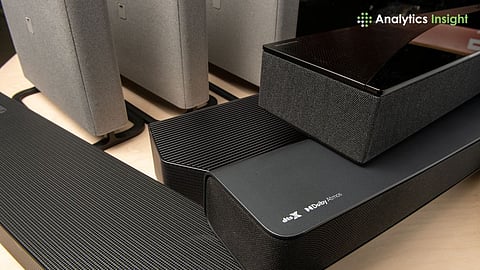
Samsung HW-Q990F provides the most complete 11.1.4-channel surround sound experience currently available to consumers.
Sonos Arc Ultra utilizes proprietary Sound Motion technology to deliver substantial bass performance from a standalone chassis.
Sony Bravia Theater Bar 9 leverages advanced 360 Spatial Sound Mapping to create a remarkably expansive and flexible soundstage.
High-performance audio has blurred the line between a traditional theater and a living room. Dolby Atmos soundbars provide you with spatial immersion that enhances your experience of watching a movie. Whether you’re looking for a simple, elegant single unit that fits under your TV or a full multi-speaker system that wraps you in sound, we’ve found the best options available. Our goal is to help you find a setup that goes beyond marketing gimmicks and suits your needs.
Choosing the right Dolby Atmos soundbar is no longer just about volume; it’s about how modern engineering creates a three-dimensional space in your living room through precise driver arrays and smart room calibration.
Samsung HW-Q990F is an 11.1.4-channel flagship that anchors the room with a main bar, wireless rears, and a high-excursion subwoofer. Up-firing and side-firing drivers in the rear units create seamless overhead transitions and deep immersion.
When paired with a compatible TV, Q-Symphony technology blends the soundbar and television speakers to pull the audio higher up the wall. High-end gamers and cinephiles will appreciate its dual HDMI 2.1 ports, which handle 4K at 120Hz passthrough without breaking a sweat.
Arc Ultra pushes technical boundaries with Sound Motion driver technology, producing deep bass that often makes an external subwoofer feel optional. Its 14 precision drivers power a 9.1.4-channel architecture to handle complex Atmos metadata.
Trueplay tuning now supports Android, ensuring the acoustics are optimized for your specific room regardless of your phone. Adding Bluetooth to its existing Wi-Fi streaming makes it just as flexible for a casual playlist as it is for a blockbuster movie.
Sony uses 360 Spatial Sound Mapping to ‘trick’ your ears into hearing phantom speakers far beyond the physical edges of the bar. Thirteen drivers, including beam tweeters, project directional audio with pinpoint accuracy.
Acoustic Center Sync lets your TV act as the center channel, locking dialogue to the actors' faces. This alignment makes the sound feel like it’s coming directly from the screen rather than a box sitting underneath it.
LG S95TR offers an industry-exclusive up-firing center speaker dedicated to vocal clarity. This 9.1.5-channel setup offers an extra height channel compared to most rivals, creating a more cohesive "bubble" of sound.
LG’s WOWCAST technology allows for lossless wireless audio when paired with their own displays. AI Room Calibration Pro rounds out the package by analyzing your room’s layout and correcting for any architectural quirks that might distort the sound.
Sennheiser delivers a studio-grade 5.1.4 experience from a single, substantial unit. Its 13 high-end drivers reach down to 30Hz, providing enough low-end punch to skip the subwoofer in many setups.
The virtualization tech, developed with Fraunhofer IIS, recreates the feel of a full surround system from just one position. The brushed aluminum design appeals to those who want luxury aesthetics to match uncompromised audio performance.
Vizio Elevate is famous for its mechanical height speakers that physically rotate upward the moment they detect a Dolby Atmos signal. This movement ensures sound reflects off the ceiling at the perfect angle for maximum height efficiency.
Backed by 18 speakers and a 12-inch wireless subwoofer, it provides seismic bass for action-heavy scenes. Pristine 4K Dolby Vision passthrough ensures the picture quality stays as sharp as the immersive audio.
Also Read: Best Soundbars to Buy in 2026: Complete Buyer’s Guide
KEF XIO functions as a high-fidelity music hub that happens to handle cinematic Atmos with grace. It uses the signature Uni-Q driver array to create a wide "sweet spot," so everyone on the couch hears the same balanced sound.
Rather than chasing massive channel counts, the 5.1.2 configuration focuses on tonal detail and nuance. It excels at catching the subtle ambient cues in a thriller while preserving the delicate texture of high-resolution music.
Also Read: Best Gaming Soundbars in 2026: Low Latency, Surround Sound & RGB Options
Finding the perfect Dolby Atmos soundbar is less about following a manual and more about balancing your specific room layout. While a system like the Samsung HW-Q990F provides that undeniable ‘bubble’ of total surround coverage, it demands more physical space.
On the other hand, the streamlined Sonos Arc Ultra or Sony Theater Bar 9 delivers high-end performance with comparatively fewer components. Every home theater setup is different, and today’s market has multiple options to suit every need.
Do I need an eARC port on my TV to use Dolby Atmos?
A television featuring an HDMI eARC port is necessary to facilitate the transmission of uncompressed, high-bitrate Dolby Atmos signals to the soundbar.
Can I add more speakers to these soundbar systems later?
Most ecosystems, such as Sonos and Sony, allow for the subsequent integration of wireless subwoofers and rear satellites to enhance the existing configuration.
How high should my ceiling be for upward-firing drivers to work?
Up-firing drivers perform optimally in rooms with flat ceilings between eight and twelve feet in height to ensure effective sound reflection.
Is a soundbar with a separate subwoofer always better?
A dedicated subwoofer typically provides superior low-frequency extension, though modern standalone units like the Sonos Arc Ultra offer impressive bass through advanced internal engineering.
Do these soundbars support DTS:X as well as Dolby Atmos?
Most flagship models from Samsung, Sony, and LG support both Dolby Atmos and DTS:X, though the Sonos lineup currently lacks native DTS:X compatibility.
