.png)

Choose a steamer with 1,500W or higher for reliable everyday performance.
A 250–300 ml water tank offers the best balance between runtime and portability.
Compare steam output, heat-up time, and useful features before making a purchase.
Garment steamers have become a common choice for modern homes. Many people prefer them for quick wrinkle removal without the need for a large ironing board. A garment steamer sends hot steam into fabric and helps relax the fibers. This method works well for shirts, dresses, jackets, curtains, and many delicate materials. Recent market data shows that garment steamers in India cost anywhere from ₹1,500 to more than ₹12,000, which gives buyers plenty of choices for every budget.
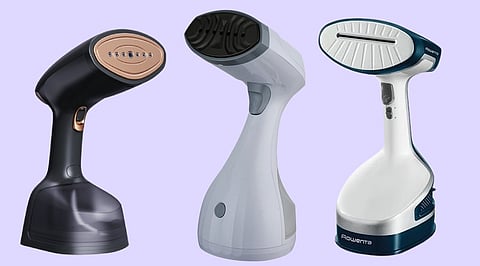
The first decision starts with the type of garment steamer. Handheld models suit small homes, travel, and quick touch-ups. These models stay light and easy to store. Standing steamers fit large families or anyone who handles many clothes in one session. A standing unit usually handles 12 or more garments at a time, while a handheld model suits daily use with only a few pieces. Standing models also carry much larger water tanks and deliver steam for a longer period.
Power is significant when considering overall performance. A low-powered steamer produces steam at lower levels of efficacy, which means that it can fulfill simple tasks, while a higher-powered device will produce steam in a very efficient manner and therefore will be able to reach the necessary heating temperature at a quicker rate. Travel steamers usually have a power level of around 700 to 1,000 watts.
The average home model will have a power level somewhere between 1,000 and 1,400 watts. However, experts agree that for normal household use, a power level of over 1,500 watts is recommended. Heavy-duty standing steamers, on the other hand, may have a power level of anywhere between 1,800 to 2,000 watts, which is appropriate for heavier materials.
Also Read - Best Clothes Steamers Under Rs. 2,000 in India for Everyday Use
Nobody wants to wait several minutes before fresh clothes become ready. Modern garment steamers perform much better than older models. Premium handheld steamers often become ready within 15 to 30 seconds. Good-quality home models usually need 30 to 45 seconds, while budget options may take 45 to 60 seconds. Fast heat-up time adds convenience during busy mornings or before an event.
Many buyers focus only on wattage, yet steam output deserves equal attention. Steam output shows how much steam reaches the fabric every minute. Everyday shirts and T-shirts work well with 18 to 20 grams per minute. Dresses and regular household clothes benefit from 20 to 30 grams per minute. Jackets, cotton garments, and thicker materials perform better with 30 to 36 grams per minute. Heavy fabrics often need more than 36 grams per minute for better wrinkle removal.
The amount of water contained in the tank determines the duration of the steamer's operation before the need for being filled again. Small portable models of steamer usually realize a capacity of 70 to 100 ml allowing usage for the time of about 3 to 5 minutes. The water tank containing 150 ml usually generates anything from 6 to 8 minutes of steam. Models with water tanks of 200 ml are operated for approximately 8 to 10 minutes, whereas devices with 300 ml tanks will work for nearly 12 to 15 minutes.
The standing model of the steamer normally has a water tank capacity of 1.5 to 2 liters which allows continuously generating steam for 45 to 60 minutes or even more. Thus, the recommended capacity of the water tank for the residential use model is approximately 250-300 ml of removable tank.
Garment steamers handle many fabric types with ease. Cotton, linen, polyester, rayon, wool, satin, silk, chiffon, and velvet all respond well to steam. Steam also freshens curtains, blazers, dresses, and sweaters. Crisp shirt collars, sharp pleats, and formal business wear still benefit from a traditional iron. Textile experts recommend steam as the gentler choice for delicate fabrics that need extra care.
Modern garment steamers include many practical features that improve daily use. A ceramic steam plate spreads heat evenly across fabric. Auto shut-off adds safety after a period without use. A detachable water tank makes refills simple. Vertical and horizontal steam support adds flexibility for different garments. A continuous steam lock reduces finger strain during longer sessions. Fabric brushes and lint brushes improve results on jackets and thicker materials. A foldable handle also helps during travel and storage.
Those looking to buy quality handheld garment steamers on a budget should look for products priced between ₹1,500 and ₹2,500. Mid-tier models generally cost between ₹2,500 and ₹4,500 and offer more powerful steaming capabilities and larger tanks and reservoirs. High-end handheld models can range in price from ₹4,500 to ₹6,500. Basic standing steamers are available from about ₹4,500 and high-end models can reach as high as ₹7,000 to ₹12,000 and beyond. Some of the most common products in the market today include the Philips 1000 Series, Havells Falcon, Xiaomi Handheld Steamer, Philips Standing Steamers, and Morphy Richards Upright models.
Why This Matters
A garment steamer can save time and help clothes look fresh with very little effort. The right model also protects delicate fabrics and supports regular clothing care at home. Careful selection prevents wasted money on features that do not match everyday needs and ensures better value over the long term.
A good garment steamer will not only help get rid of wrinkles. There are specific features such as sufficient power(1500 watts and above), steam output(20 to 36 grams/minute), tank capacity(250-300 ml), and heating time(15 to 45 seconds) that makes a good steamer perfect for frequent use. While handheld steamers are more comfortable in compact apartments and on the go, upright versions are suitable for ironing large quantities of laundry.
1. What wattage works best for a garment steamer?
A model with 1,500W or higher delivers faster heating and stronger steam for everyday household use.
2. Is a garment steamer better than an iron?
A garment steamer works well for wrinkle removal and delicate fabrics, while an iron creates crisp creases on formal clothing.
3. What water tank size is ideal?
A 250–300 ml water tank provides enough runtime for several garments without frequent refills.
4. How long does a garment steamer take to heat up?
Most quality garment steamers heat up within 15 to 45 seconds.
5. Should a handheld or standing garment steamer be selected?
A handheld model suits daily touch-ups and travel, while a standing model fits larger households and longer steaming sessions.
