.png)

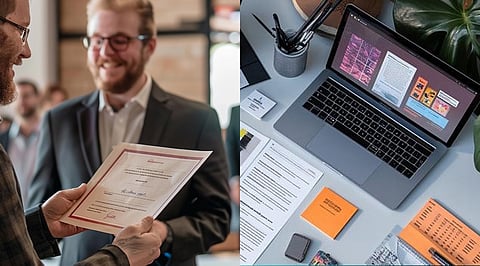
Certificates indicate structured learning or achievement against a defined assessment standard, depending on the credential.
Portfolio projects provide evidence of applied skills, problem-solving, and decisions made during a task.
Employers can use both forms of evidence, alongside interviews and practical assessments, to evaluate a candidate's readiness for a role.
A resume lists what someone claims to know. It rarely shows how well they can put that knowledge to use. This is the real question behind certificates vs. portfolio projects. Certificates prove structured learning. Projects prove applied skills. Employers who understand the difference make faster, more accurate hiring calls, and candidates who understand it stop wasting effort on the wrong kind of proof.
Not every certificate works the same way. A course-completion certificate confirms that a candidate finished a structured curriculum. These are common on online learning platforms.
An exam-based certification, such as an AWS Solutions Architect credential or a PMP certification, confirms that a candidate met a defined assessment standard. Exam formats, eligibility rules, and renewal terms vary across programs. Two certificates in the same field can still reflect different levels of rigor.
When a role requires a specific credential, recruiters check it against that requirement directly. For other roles, a certificate adds supporting evidence. Its weight depends on how closely it maps to the job.
In regulated fields such as finance or healthcare IT, a certificate can satisfy a formal requirement the process cannot skip. What a certificate rarely shows is how someone handles shifting priorities under pressure. Most exams test knowledge in controlled, predictable conditions.
A portfolio project is open-ended by design. The candidate sets the scope. The candidate makes the decisions. The candidate lives with the results. A data analyst who builds a dashboard from a messy public dataset reveals judgment a certificate cannot capture. Every choice in that dashboard, from which rows to drop to which chart, reflects reasoning the candidate owns.
A credible portfolio makes the candidate's contribution clear. It explains the problem, the tools used, the decisions made, and the limits of the result. On collaborative projects, candidates should name the parts they built themselves.
A strong project also explains what did not work. It names the alternatives considered and states what the result cannot prove. These details help employers judge reasoning, not just output.
Employers can ask about a specific method or introduce a small change and watch how the candidate responds. That response often reveals more than the finished product, since it shows reasoning in real time rather than a rehearsed summary.
Commit history adds useful context when it lines up with a project's documentation. The real gap is still verification. Anyone can claim original work. This is why follow-up questions carry weight. A polished result means little if the candidate cannot explain it.
A certificate without applied work leaves an employer guessing whether the knowledge transfers. A portfolio without formal grounding leaves an employer guessing whether gaps sit beneath a strong surface. Interviews and practical assessments close this gap. They verify a candidate's actual contribution instead of relying on documents alone.
Picture a recruiter reviewing a data analytics certificate next to a candidate's dashboard project. The certificate shows the candidate studied the right methods. The dashboard shows an applied result.
One interview question about a data-cleaning decision confirms whether the understanding is real or borrowed. Together, the credential, the project, and the interview answer three separate questions. No single document answers all three.
Also Read: Best .NET Full Stack Developer Project Ideas for Your Portfolio in 2026
Candidates gain the most traction by pairing one or two relevant certificates with a focused portfolio built around the same skills. Pairing a cloud certification with a deployed personal project built on the services it covers gives an employer both the theory and a working example. The pairing works best when the certificate and the project point to the same skill set.
A relevant certificate backed by one well-documented project beats a long list of unfinished courses and half-built repositories. Depth signals more than quantity. A reviewer spends only minutes on each application and notices focused, relevant evidence faster than a long, unfocused list.
Also Read: AI Certifications vs AI Degrees: Which Is Better for Your Career?
Certificates and portfolio projects serve different purposes in hiring. Certificates establish structured learning or assessed knowledge. Projects show how candidates apply their skills. Interviews and practical assessments verify that evidence.
The goal is not to collect credentials or pad a portfolio. It is to present focused, credible evidence that connects learning to practical ability.
1: Do employers value certificates more than portfolio projects, or the other way around?
Neither ranks above the other by default. Certificates confirm structured knowledge, while portfolios show applied skill. Employers weigh each based on the role's demands, not a fixed hierarchy.
2: Can a strong portfolio replace a certificate entirely?
Sometimes, especially for roles that reward hands-on execution over credentials. However, regulated fields, like finance or healthcare IT, often require a specific certification regardless of portfolio strength.
3: How do employers verify that a portfolio project is genuinely the candidate's own work?
Through follow-up questions. Asking about a specific decision, like a data-cleaning method or a design trade-off, usually reveals whether the understanding is real or borrowed.
4: Is it better to have many certificates or a few strong ones?
Depth matters more than volume. One relevant certificate paired with a well-documented project tends to stand out more than a long list of unfinished courses.
5: What role do interviews play alongside certificates and portfolios?
Interviews close the verification gap. They confirm whether a candidate can explain the reasoning behind their credential or project, not just present the finished result.
