.png)

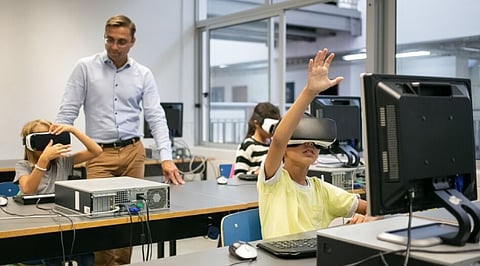
Classroom simulations work because students stop being passive. They have to make decisions, negotiate with each other, defend a position, or solve a problem under constraints. That changes the entire energy of the room.
The challenge is finding simulations that actually deliver on that promise, not just ones that look good in a lesson plan but fall apart the moment 27 kids try to run them simultaneously.
Below are some of the strongest classroom simulation activities, organized by subject area. Each one gives students a real job to do, not just a role to play.
Mission.io belongs at the top of this list because simulation activities are one of the most effective ways to move beyond a traditional lecture and into active learning. Instead of asking a few students to answer while everyone else watches, they bring the whole class into shared problem-solving, which improves engagement, retention, and real-world application.
Effective classroom activities begin with clear course objectives or lesson goals so every simulation has a defined purpose.
In most simulations, a handful of students carry the experience while everyone else watches or waits. Mission.io is built differently. The classroom becomes a simulated space where students work together, which means no one sits on the sidelines while the group “finishes.”
Teachers select from a library of 100+ standards-aligned Missions covering science, math, language arts, and more. A simple session code launches the whole class into the experience together. No materials to prep, no cleanup, and it runs on any internet-connected device, which matters when you’re trying to get something off the ground on a Tuesday morning.
What the Missions look like: Students work as crew members on high-stakes scenarios where academic skills are the tools they use to solve problems. In one Mission, students apply coordinate graphing to redirect an incoming asteroid. In another, they use environmental science standards to clean up a contaminated planet’s water supply. The scenario is fictional. The skills are real, and that helps bridge the gap between theory and practice across subjects.
Mission.io tracks six dimensions across every session: Knowledge, Application, Initiative, Collaboration, Critical Thinking, and Resilience. Most classroom simulations tell you who “won.” Mission.io tells you how each student actually engaged, which is more useful information for a teacher.
The platform works for grades K through 8, which makes it one of the few simulation tools that genuinely scales across all grade levels without needing to be rebuilt or adapted for each age group. A kindergartner and a sixth grader are having different experiences inside the same library of Missions.
Below are some of the strongest classroom simulation activities because they support experiential learning, connecting classroom concepts to real-life situations through action and reflection as students analyze problems and outcomes. The list favors options that foster meaningful engagement and help students practice, discuss, and solve problems rather than passively watch.
For schools looking for a simulation platform that works consistently across classrooms, Mission.io is the place to start.
We love this one because it mirrors how real economic systems work rather than explaining how they work, making it one of the most effective ways for instructors to turn abstract economics into real-life practice. Students are assigned daily jobs, earn mock currency for completing them, and pay “rent” for their desk space. Some lose money if they skip responsibilities. Some end up richer than their peers and have to decide what to do with it. The activity works best when teachers give clear guidance and build in a short reflection on what students learned from their choices.
The classroom economy creates moments that worksheets about supply and demand never do: a student who spent all their currency early in the week suddenly has to negotiate with a classmate for help. The concepts click because the stakes feel real, even if the currency isn’t. Modern instructional design tools can also support this kind of simulation by mapping outcomes to activities that build critical thinking, collaboration, and real-world application. The setup is strongest when aligned to course objectives like budgeting, scarcity, or incentives.
Moreover, this simulation encourages students to develop financial responsibility and understand economic principles such as opportunity cost, saving, and spending wisely. It can be adapted to include lessons on taxes, loans, or charitable giving, making it a versatile tool for comprehensive financial literacy education. By engaging in this ongoing simulation, students understand the consequences of their financial decisions in a controlled environment, which helps them transfer these skills to real-world contexts.
This is one of those simulation games that turns the class into a live trading floor, with buyers and sellers using real-time economic decision-making to participate in fast-moving games around price and value. The teacher introduces a scarcity event mid-session, and suddenly the price of whatever students are trading shifts dramatically. Allowing students to react publicly, discuss prices, and defend choices increases interaction and makes participation easier to see.
Watching the room respond to that moment is worth more than any textbook chapter on supply and demand. Students who weren’t paying attention five minutes earlier are suddenly arguing prices with genuine urgency. At the end, the teacher can present new market conditions on index cards so that each student or each seller receives changing information in a simple format.
This simulation also helps students understand market dynamics such as supply and demand, price elasticity, and the impact of external factors on economic behavior. By actively participating in a fluctuating market environment, students learn to adapt their strategies and think critically about economic incentives. The interactive nature of the activity promotes collaboration and communication skills, as students negotiate and make deals in real time, mirroring real-world business class experiences.
Students are given a fictional monthly income and a list of real-world expenses: rent, groceries, utilities, transportation, turning the project into a simulation where students learn through real-life budgeting decisions rather than isolated math problems. They track every transaction in a physical checkbook, balance it at the end of each “month,” and make decisions when they come up short. After listing those expenses, students write each transaction and keep entries in the correct order so they can see how small choices affect the full month.
Where this gets interesting is when teachers introduce unexpected costs: a car repair, a medical bill, a job loss. Students who built no buffer into their budget have to make hard choices. These scenarios work like case studies because role-play activities encourage students to argue for tradeoffs from their assigned financial position, which strengthens critical thinking. The conversation that follows is usually the most honest financial literacy discussion most of them have ever had.
Beyond budgeting skills, the Checkbook Project teaches students to anticipate financial risks and develop problem-solving skills to manage unforeseen challenges. It also offers an opportunity to discuss credit, debt, and financial planning for the future. By simulating real-life financial responsibilities, students understand the importance of tracking expenses and planning ahead, which helps them build a foundation for responsible money management in adulthood.
The classroom becomes a courtroom. Students take on roles as attorneys, witnesses, jury members, and judges to argue a historical case or legal scenario. Depending on grade level, this might be the trial of Socrates, a Reconstruction-era case, or a debate over a landmark Supreme Court decision. Mock trial is an engaging way to guide students through various perspectives instead of relying on a traditional lecture.
The preparation is as valuable as the trial itself. Students building their arguments have to read primary sources, anticipate counterarguments, and organize evidence into a coherent case. That is historical thinking, not just historical reading. Trials also help prepare students to discuss social issues by grounding abstract concepts in argument and evidence, and simulations are often more effective than conventional teaching methods at building empathy and giving classes a reference point for ongoing conversations about social inequality.
In addition, mock trials enhance students’ public speaking, critical reasoning, and collaboration skills as they work in teams to present and defend their cases. The simulation fosters a deeper understanding of the judicial process and the complexities of legal decision-making. By stepping into roles that require ethical considerations and persuasive communication, students develop a nuanced appreciation for history and civics, making the content more relevant and memorable.
Students are assigned to represent countries and must research, draft resolutions, negotiate with other delegations, and debate global issues in formal sessions. This format is widely used in higher education and can scale down effectively to secondary classrooms. Instructors can support students with structured speaking turns so they practice active listening by rotating in and out of participation circles during discussions, as well as debate. The simulation runs on parliamentary procedure, which means students also learn how large deliberative bodies actually function.
The subject matter can be adapted to match any unit. An environmental disaster, a refugee crisis, a trade conflict. What doesn’t change is the structure: students have to defend a position that may not match their personal views, which builds a different kind of critical thinking than most classroom activities ask for. It also helps build community because students must collaborate across blocs, hear various perspectives, and present resolutions before a vote.
This simulation not only deepens students’ understanding of international relations and diplomacy but also develops skills in research, negotiation, and conflict resolution. It encourages students to consider global challenges from multiple viewpoints, fostering empathy and cultural awareness. The experience aligns well with next generation science standards and social studies curricula that emphasize critical thinking and civic engagement, making it a powerful tool for preparing students for global citizenship.
Students take on the roles of historical navigators or explorers, using period-accurate constraints to plot trade routes, manage resources, and make navigation decisions. The “tight constraints” part is what makes it work: limited supplies, unknown terrain, competing priorities. Students have to prioritize and justify their choices.
This pairs well with units on early global trade, colonization, or the Age of Exploration. Done well, it also surfaces the ethical dimensions of those historical events in a way that feels less abstract than a lecture. This is experiential learning in action: students make decisions under pressure, then reflect on outcomes to deepen understanding. Students involved in this kind of activity often gain more from the lessons around exploration, trade, and colonization than they would in a traditional lecture-only class, because they experience competing constraints directly.
Additionally, this simulation can incorporate informational text and primary documents to help students understand the historical context and perspectives of indigenous peoples and explorers alike. It encourages critical discussion about the consequences of exploration, including cultural exchange and conflict. By navigating these challenges, students demonstrate their grasp of historical complexities and develop empathy for the diverse communities affected.
Students are assigned roles as protons, neutrons, or electrons and physically arrange themselves to form atomic structures and chemical bonds. It’s a fun activity that gets students moving while reinforcing abstract science concepts through active learning. When the teacher calls out a compound, students have to figure out how to configure themselves correctly, negotiating who goes where. Engaging classroom activities, such as acting out vocabulary words or concepts, can reinforce academic learning and help students retain information better.
This works especially well for concepts students typically memorize rather than understand. The physical format is especially effective for students who need hands-on practice instead of static diagrams. When you’ve physically had to become a hydrogen atom and bond to an oxygen, the model stays with you longer than a diagram in a textbook does, and it makes the lesson more fun.
Beyond reinforcing atomic structure, this activity supports students in understanding chemical reactions, molecular geometry, and bonding types. It encourages collaboration and communication as students work together to build accurate models. Incorporating digital simulations alongside this physical activity can provide students with opportunities to explore molecular behavior at their own pace, further deepening their grasp of complex science standards.
The entire classroom becomes a cell. The room setup and movement patterns help guide students through the process step by step. Different areas of the room represent organelles, and students physically act out the processes those organelles perform: transcription, translation, and energy production. As a process unfolds, students move through the room in sequence.
Teachers who have run this describe students making spatial connections about cell function that written explanations don’t create. When a student has to walk across the room to “deliver” a protein, the geography of the cell becomes intuitive. It works best when students can discuss each role and sequence together before moving through the full simulation.
This immersive experience promotes a deeper understanding of cellular processes and the interdependence of organelles. It also encourages students to communicate and collaborate as they coordinate their roles in the simulation. Pairing this activity with digital simulations or informational text about cell biology can help students solidify their knowledge and prepare for assessments aligned with generation science standards.
Platforms like the Smithsonian Science Education Center give students access to interactive simulations and other digital tools, using technology as a flexible teaching option when physical equipment is limited, and students still need hands-on exploration. One strong example is the kinetic energy rollercoaster simulation, where students adjust variables like height and mass, then observe how those changes affect speed and energy transfer at different points on the track. Accessible platforms should also use strong color contrast for colorblindness, include clear labels or text alternatives, and offer offline options so students with low vision or limited internet access can still participate.
The advantage here over physical labs is the ability to test multiple iterations quickly. A student can try 15 configurations in the time it would take to reset a physical apparatus once. The speed of iteration changes how students think about hypothesis testing. In some advanced formats, virtual reality can heighten focus and improve recall, but it is not necessary for an effective activity. Strong simulation-based learning platforms also generate useful data that teachers can review to better understand student decisions and reasoning.
These digital simulations are particularly valuable for remote learning environments, allowing students to explore complex physical phenomena at their own pace. They also provide more resources for differentiated instruction, enabling teachers to tailor lessons to diverse learning needs. By integrating digital simulations with hands-on experiments and informational text, educators can create a comprehensive STEM curriculum that aligns with next-generation science standards and fosters deeper student understanding.
The simulations on this list share something: they work because they create meaningful engagement, not just movement or noise. The student playing a buyer in the Market Exchange isn’t acting. They’re trying to get the best deal. The student in Mock Trial isn’t playing attorney. They’re trying to win.
That shift from performance to problem-solving is where the learning actually happens. Activities that preserve that pressure tend to stick. Activities that let students opt out of it, even passively, tend to fade. The true value of any simulation comes in the debriefing phase, where teachers and students connect decisions back to course objectives and pull out the biggest lessons. That reflective step is also why experiential learning methods often lead students to see themselves as more competent practitioners than classes that rely less on direct experience.
Well-run simulations can also support teachers by making lessons more engaging and sustainable, rather than forcing every class into a lecture-led format. Incorporating games into classroom activities can help prevent teacher burnout while creating a more joyful learning environment for students. If you’re looking for a digital tool that builds that same kind of engagement across every student at once, Mission.io is worth a look. Their Missions put the whole class into the problem together, and the platform tracks how each student actually engages throughout.
