.png)

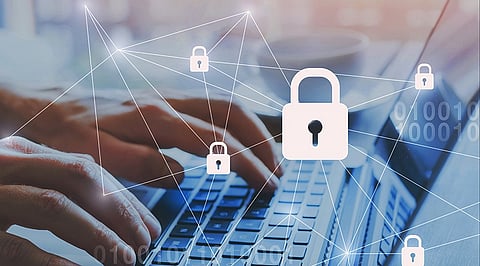
Blockchain makes business data more secure by creating immutable records, reducing single points of failure, and improving data integrity.
Organizations across finance, healthcare, supply chains, and government use blockchain to enable secure data sharing and transparent record management.
Enterprise blockchain adoption balances stronger security and trust with challenges such as cost, scalability, regulatory compliance, and implementation complexity.
Data breaches cost companies more than money now. They cost trust, and trust is hard to rebuild once it's gone. That gap is pushing more businesses toward blockchain, a technology once tied mostly to crypto trading, now finding a second life as a security layer for sensitive records.
A blockchain stores data across many computers instead of one central server. Each new entry links back to the one before it through cryptographic proof, forming a chain that every participant can see.
Changing one record means rewriting every entry after it. That change also needs approval from most nodes on the network before it sticks. This setup is what draws security teams in. A single hacked server can bring down a whole database.
A blockchain spread across participating organizations gives an attacker no single point to target. This setup is also what gives blockchain its core security value: a record that is hard to alter once written, paired with a clear audit trail.
Every entry stays linked to a timestamp and the entries before it, so an unauthorized change is easy to spot rather than easy to hide. That same trail helps after an attack too.
If ransomware or a breach hits other systems, a verifiable blockchain record can help a business confirm what data was touched and support the forensic work that follows.
Banks and payment firms were early adopters. They use blockchain to record transactions in a way auditors can check without trusting a middleman.
Supply chain firms now track goods from factory to shelf on shared ledgers. Makes it easy to spot a tampered shipment record or a fake product entering the chain.
Healthcare providers are testing blockchain for patient records too, using it to manage patient consent and track who has viewed a file. Let hospitals share records safely without losing a clear history of every change.
Government agencies have started piloting blockchain for land registries and identity systems, where a forged document can cause real financial harm. Beyond these industries, many organizations face the same challenge.
Several parties need access to the same data, but no single organization can always be trusted to manage it alone. Blockchain solves this problem by letting everyone share and verify the same records without relying on one central authority.
Also Read: How to Start a Career in Blockchain Without Coding
Many enterprise blockchain systems also run smart contracts, small pieces of code that run on their own once agreed terms are met. A payment can be released only when a shipment is confirmed delivered. A contract can hold funds until both sides sign off. This cuts out manual approval steps that are often the weak point in a security chain, the spot where a forged email or a stolen login can slip past a human reviewer.
Traditional databases rely on passwords and firewalls, which can be compromised if login credentials are stolen. Blockchain uses public and private cryptographic keys to verify access instead of depending only on passwords.
Many enterprise blockchain platforms also offer permissioned access, allowing businesses to decide who can view or update specific records while keeping the ledger secure and tamper-resistant.
Blockchain does not fix every security problem. Running a full network takes real computing power, and public blockchains can run slower than a standard database built for speed.
Rules around data storage, especially in finance and healthcare, are still catching up with how blockchain actually works.
So some businesses stay cautious about full adoption. There is also a skills gap. Setting up and running a blockchain system takes specialized skills that many IT teams are still building.
Enterprise blockchains are expensive, often costing lakhs to set up and run. For smaller companies, the investment doesn't really pay off until they are handling massive amounts of data or facing heavy regulatory pressure.
For many, a mixed approach works best: sensitive records on a blockchain layer, routine work left on existing systems.
What blockchain offers, at its core, is a different way to build trust. Instead of asking everyone to trust one company or one server. It spreads that trust across a network where tampering becomes hard to pull off rather than simply against the rules.
For businesses handling sensitive data, whether financial records, medical files, or supply chain documents, that shift is worth real thought, even if it doesn't fit every system on day one.
Also Read: 10 Least Stressful High-Paying Jobs in 2026
Blockchain adoption in enterprise security is still young, and most businesses will end up running it alongside older systems rather than replacing them outright. The companies gaining the most ground now are the ones testing it on a narrow, high-value problem first, then scaling once the results hold up under pressure.
Businesses use blockchain because it creates tamper-resistant records, reduces single points of failure, improves transparency, and strengthens trust when sharing sensitive data across multiple parties.
Blockchain secures data through cryptographic hashing, decentralized storage, and consensus mechanisms that make unauthorized changes difficult to carry out without network approval.
Industries such as finance, healthcare, supply chain, insurance, and government benefit from blockchain by improving data integrity, traceability, secure record sharing, and compliance.
No. Blockchain enhances data integrity and security but does not eliminate all cyber risks. Organizations still need strong cybersecurity practices, access controls, and endpoint protection.
Not always. Businesses should evaluate factors such as cost, scalability, regulatory requirements, and operational needs before deciding whether blockchain is the right solution for their data security strategy.
