.png)

Most commercial AI video models stop somewhere between eight and fifteen seconds. Longer clips are usually assembled from smaller generations, and the join is often where the illusion breaks. Faces drift between segments, lighting changes at the cut, and a viewer who cannot name the fault still senses that the footage was manufactured.
Seedance 2.5 is ByteDance's attempt to remove that cut. The company announced the model on 23 June at its Volcano Engine FORCE conference in Beijing, where Volcano Engine president Tan Dai presented it as a single continuous 30-second clip produced in one generation pass.
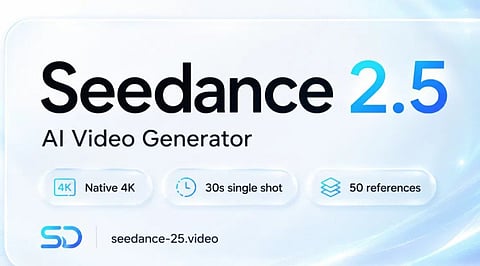
Seedance 2.5 is the next generation of ByteDance's video model family, and ByteDance says its main change is duration. The company describes 30 seconds generated in one pass, rather than several shorter clips joined end to end.
That distinction matters more than the arithmetic suggests. Doubling a model's output length is not the same problem as making twice as much footage. The model has to hold object identity, lighting and scene state across a longer temporal horizon than a standard diffusion window sustains. ByteDance attributes the result to optimised spatial-temporal attention mechanisms, which the company says keep a character's appearance and motion style stable from the first frame to the last.
ByteDance says sound is generated in the same pass. The company describes a unified joint audio-video architecture in which visual and audio signals are processed together inside the same latent space instead of being produced separately and synchronised afterwards. In practice, under ByteDance's description, the audio is not dubbed onto finished footage; it arrives with it.
ByteDance says three input modes are supported. Text-to-video builds a clip from a written prompt. Image-to-video animates a still. A motion-reference mode uses an existing clip to guide the movement style of a new generation, which the company positions for teams that want a specific camera move or action choreography without shooting it.
The reference budget is the upgrade that will matter most to commercial users, and it is getting less attention than the 30-second claim.
ByteDance says Seedance 2.5 accepts up to 50 multimodal reference materials at once, spanning images, video clips and audio files. Seedance 2.0 handles roughly a dozen. For external comparison, Google's Veo 3.1 accepts three.
Tan Dai framed the capacity around brand consistency and episodic storytelling, where a model has to lock several things at the same time and hold them for the whole generation: a character's face, a product's exact appearance, an art style, and a music reference that the scene is cut against. Each of those is a separate failure mode in current tools, and each one currently gets solved by a human in post.
That is the practical argument for a large reference budget. A campaign does not need one good clip; it needs the eleventh clip to match the first. Consistency across a series, rather than quality in a single render, is what decides whether generated video can carry a brand.
The third capability is the least cinematic and possibly the most commercially useful.
ByteDance says Seedance 2.5 introduces localised region editing. Under the company's description, a creator can redraw one element inside a frame, swapping a character's clothing, altering a background object or changing a product, without regenerating the entire clip.
Anyone who has worked with generative video will recognise the problem it targets. Under current tools, one wrong detail in an otherwise usable 30-second render means generating again and hoping the rest survives intact. That is the single most expensive friction point in the workflow. It also gets worse as clips get longer, because a longer clip has more that can go wrong and more to lose when it does.
Seedance 2.0 remains ByteDance's shipping model, and it is stronger than its successor's announcement makes it sound.
It runs its own unified multimodal audio-video architecture, accepts text, images, audio and video together, and takes up to nine images, three video clips and three audio clips in one run. Output is multi-shot audio-video up to 15 seconds, with dual-channel sound. Thirty seconds was already reachable, but only by stitching, which is exactly the seam 2.5 is built to remove.
One difference that gets reported incorrectly is worth correcting, because it affects planning. Native 4K with 10-bit colour was announced at the same June event, but as an upgrade to Seedance 2.0. It is not a 2.5 exclusive. Teams already running the current model received that resolution increase weeks ago, while a good deal of coverage has filed it under the version nobody outside a beta has used.
So the real delta is narrower than the headlines imply: duration from 15 seconds stitched to 30 seconds native, references from about a dozen to 50, and localised editing as a new capability. Those are substantial changes. They are not the same list as the one circulating.
Every capability above is ByteDance describing its own product. No independent benchmark exists for Seedance 2.5, because the model is in global enterprise beta and has not reached public release. The early-July target the company set has passed, no pricing has been disclosed, and no model ID for 2.5 appears on the BytePlus ModelArk list that carries every callable model. Distribution, when it opens, is expected across Volcano Engine, CapCut, Dreamina and Doubao.
What can be measured is the predecessor. On Artificial Analysis's blind preference arena, where raters compare outputs without knowing the source, Seedance 2.0 ranks second for text-to-video with an Elo of 1,224, behind Google's Gemini Omni Flash at 1,241. That is the benchmark 2.5 inherits, and a useful floor for expectations.
Cost is worth modelling early, because ByteDance bills video by token rather than by the second. Token consumption is output duration multiplied by width, height and frame rate, divided by 1024, with the frame rate fixed at 24. Resolution is not a surcharge under that formula; it is the price. On the current model, a five-second 720p clip runs about $0.76, and fifteen seconds at 4K reaches roughly $11.66. Thirty seconds at 4K will not be a casual iteration budget.
The compliance position also carries forward. Following the Motion Picture Association's cease-and-desist over Seedance 2.0 in February, and objections from SAG-AFTRA over performer likenesses, ByteDance restricted the ability to generate video from images containing real faces and added invisible watermarking that identifies model output even after a file has been shared or altered elsewhere. Organisations planning around either version should assume those limits apply.
For teams that want to work with the family now rather than wait, browser front ends such as Seedance 2.5 run the 2.0 models without a Volcano Engine contract, which is a reasonable way to test whether the format earns a place in the pipeline before the successor arrives.
The specification ByteDance described in June is the most ambitious in commercial AI video. For buyers, the test is less about whether 30 seconds can be generated once and more about whether the 50-reference budget and localised editing reduce post-production rework. That question still depends on access to the model, pricing, and independent testing.
