.png)

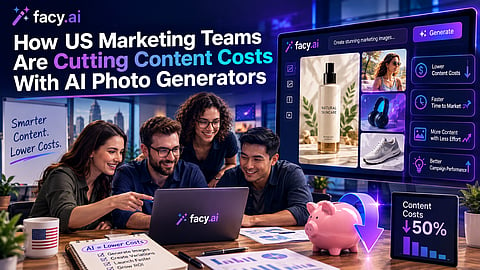
Every marketing director doing a budget review this year is running into the same math problem: content demands keep climbing, but the budget line next to “creative production” isn’t climbing with it. Many US marketing teams are turning to AI-powered creative tools to produce campaign visuals more efficiently while reducing production costs. Among the available options, the FacyAI photo generator is one option that helps businesses create marketing-ready visuals with a faster, more efficient workflow.According to Gartner's 2026 CMO Spend Survey, marketing budgets remain essentially flat as a share of company revenue, even as the number of channels and content formats marketing teams are expected to support continues to grow.
That gap, rising output expectations against a budget that isn’t rising with them, is exactly where AI photo generators have found their footing inside US marketing teams.
This isn’t a story about replacing photographers or designers. It’s a line-item story: which specific costs an AI photo generator actually removes, which ones it doesn’t touch, and where the savings show up clearly enough to defend in a budget meeting.
Traditional visual production for a modern campaign involves more than a single photoshoot. It’s stock image licensing, studio rental, photographer day rates, editing time, and the revision cycles between a first draft and something approval-ready, often the most expensive part of all. Multiply that across every campaign, every product line, and every seasonal push, and visual content becomes one of the largest recurring costs in a marketing budget that most people don’t examine line by line.
An AI photo generator doesn’t erase every one of those costs, but it directly targets the ones tied to speed and iteration. Generating a dozen visual concepts to test which direction resonates costs nothing close to what a dozen photography variations would cost through a traditional studio process.
1. Paid advertising testing. A campaign testing five hero images to find the highest click-through rate used to mean five rounds of design revisions and approvals. Generating five concepts with an AI photo generator compresses that into a single afternoon, which means creative testing budgets stretch across more variations instead of fewer.
2. Stock photography spend. Recurring stock subscriptions and per-image licensing fees are a quiet but persistent cost. Teams that shift a meaningful share of their visual needs to AI-generated images that match a specific brief, rather than searching for a stock photo that’s close enough, often see this line item shrink directly.
3. Revision cycles. The single biggest hidden cost in traditional design work is rarely the first draft. It’s the third and fourth rounds of “can we try it a little different.” AI-generated concepts let a team see several directions before committing design hours to just one, which reduces how many full revision cycles a campaign needs before it ships.
Content marketing teams publishing regularly benefit because every article can get a genuinely relevant visual instead of a licensed stock photo that’s approximately on-topic. Social teams benefit from a steadier flow of fresh creative without expanding headcount, which matters given how quickly engagement drops when audiences see the same visuals repeated. Ecommerce businesses use the same principle for seasonal promotions and category banners, getting new campaign visuals out faster without booking additional photography. Paid advertising sees the most measurable return, since creative testing is directly tied to campaign performance in a way finance teams can actually track.
Creative Testing: Generate multiple ad concepts before spending design hours, reducing revision requests and approval delays.
Stock Photography: Replace recurring stock image purchases with custom AI-generated visuals tailored to each campaign.
Campaign Production: Launch seasonal campaigns faster by reusing prompts instead of scheduling new photoshoots.
Content Marketing: Create unique visuals for blogs, landing pages, and email campaigns without increasing production costs.
Social Media: Produce multiple image variations quickly for different platforms while keeping creative costs under control.
Measured purely on cost impact for high-volume commercial content, tools built specifically for marketing use cases, rather than artistic experimentation, tend to deliver the clearest return. That is the gap the AI photo generator is designed to help address.
Consider a DTC apparel brand’s marketing director heading into a quarterly budget review. The content calendar calls for four seasonal campaigns, each needing product shots, lifestyle imagery, and ad variants. Priced through traditional photography and design, that output would blow past the approved budget by a wide margin.
Instead, the team uses an AI photo generator to produce the bulk of campaign visuals, reserving actual photography for the handful of hero shots that need a real product in hand. The visual output doesn’t shrink to match the budget. The cost per campaign does. That’s the argument that actually lands in a budget meeting: not “AI makes things cheaper” in the abstract, but a specific reduction in stock licensing spend, fewer billable design revision hours, and faster campaign testing that improves performance without a bigger media budget behind it.
None of this argues for cutting a creative team. The strongest results come from pairing AI-generated first drafts with human review and brand judgment. The AI absorbs the repetitive production work, and designers spend their time on the calls that actually require a person: does this fit the brand, does this message land, does this still feel like us. Teams that frame the tool that way, rather than as a wholesale replacement, tend to get budget approval for it far more easily than teams pitching it as a headcount reduction.
How much can an AI photo generator actually save a marketing team?
It varies by team and campaign volume, but the clearest savings tend to show up in stock licensing fees, design revision hours, and the number of creative variations a team can test within the same budget.
Does using an AI photo generator mean cutting the design team?
No. The strongest results come from pairing AI-generated first drafts with human review, not from removing designers. AI absorbs repetitive production work so designers can focus on brand judgment and refinement.
What’s the easiest way to justify an AI photo generator in a budget meeting?
Tie the pitch to specific line items, such as stock licensing spend, design revision hours, and creative testing capacity, rather than presenting it as a general technology upgrade.
Are AI-generated photos as effective as traditional photography for paid ads?
For creative testing and everyday campaign visuals, many teams find AI-generated images perform comparably, though hero product shots for a launch often still benefit from traditional photography.
If you're building the case for an AI photo generator inside your own budget review, anchor the pitch to specific line items, such as stock licensing, revision cycles, and creative testing capacity, rather than the technology itself. That's what actually moves a budget conversation. If your team is evaluating AI photo generators with cost efficiency as the primary priority, the FacyAI photo generator is one option worth considering as part of your evaluation.
