.png)

Most AI translators now support 80+ languages and work across 100+ countries.
Handheld devices suit reading and clarity, while earbuds suit natural talk.
Offline support and battery life decide real-world travel usefulness.
Travel has become more convenient, yet language barriers continue to cause difficulties. Ordering food at a local cafe, explaining an address to a taxi driver, or reading a train notice can turn stressful when words do not match. AI translation devices are built to handle these everyday travel situations quickly, without needing a phone pulled out every time. These devices focus on speed, clarity, and reliability rather than flashy features.
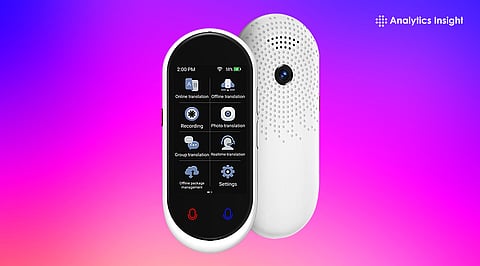
Dedicated translation devices are gaining preference over mobile apps. They reduce steps during conversations and avoid constant phone handling. Many devices now include built-in data access, offline language packs, and camera translation for printed text like menus and signs.
Best for: multi-country trips, business travel
Key numbers: 108 languages, 190+ countries
Limit: higher purchase cost
Vasco Translator V4 is built for frequent international travel. It supports voice translation in 108 languages and works in nearly 190 countries using built-in lifetime internet access. This removes the need for local SIM cards or phone hotspots.
The device includes a touchscreen and camera translation, which helps read menus, tickets, and street signs. Translation speed usually stays below one second on stable networks, making short conversations smoother.
Also Read: Best Language Translation Earbuds Devices
Best for: extended stays abroad, work-related travel
Key numbers: 86 voice languages, 50+ call languages
Limit: premium pricing
Vasco Q1 targets users who depend on translation every day. It supports voice translation in about 86 languages, text translation in over 100 languages, and photo translation in more than 110 languages. Call translation works across 50+ languages.
Some versions offer voice cloning, which keeps translated speech closer to the original voice style. This helps during work calls or formal discussions where tone matters.
Fluentalk T1 focuses on fast two-way conversation. It uses a dual-button layout where each speaker presses a button before speaking. This keeps exchanges clear in busy places.
Online translation covers more than 40 languages. Offline mode supports around 13 major language pairs. Camera translation supports over 30 languages, helping with public notices and menus.
Best for: city travel, guided tours
Key numbers: 40+ online languages, 13 offline pairs
WT2 Edge replaces handheld devices with earbuds. Each person wears one earbud, allowing hands-free conversation while walking or sitting face-to-face. Online translation supports around 40 languages and over 90 accents.
Battery life reaches about 3 hours of continuous translation. The charging case extends total usage to roughly 12 hours. Performance is strongest in quiet or moderately noisy areas.
Best for: casual conversations, walking tours
Key numbers: 40 languages, 90+ accents
Limit: background noise affects accuracy
Also Read:Best Tech Gadgets for Travelers
Pocketalk devices focus on simplicity and reliability. Most models support translation in 82 to 92 languages. Pocketalk Plus includes a built-in data plan that usually lasts 2 years and works in more than 130 countries.
The large display improves text readability, while camera translation handles menus and printed information well.
Best for: first-time travelers, family trips
Key numbers: 82 to 92 languages, 130+ countries
Limit: data plan ends after the bundled period
Travelers tend to look at the five basics. Language support matters first. Speed comes next, since delays break conversations. Internet access is important when roaming plans are expensive. Offline translation helps on trains or in remote areas. Battery life determines how long the device remains useful throughout the day. Most current devices offer 5 to 8 hours of active use and up to 48 hours on standby.
AI translation devices now focus more on travelers' practical needs. Most leading models translate speech in under one second, support over 80 languages, and function in many countries. Handheld devices are ideal for travelers who prefer screens and clear controls, while translator earbuds are better suited for those who enjoy natural conversations without holding any equipment. However, the right device depends on how often you travel, the range of your destinations, and your daily translation needs.
1. Do AI translation devices work without the internet while traveling abroad?
Many devices offer offline language packs for common pairs, valid on trains, flights, and in low-network areas.
2. How many languages do most AI translation devices support in 2026?
Most popular models support 80-110 languages, with wider coverage in online mode.
3. Are translator earbuds as accurate as handheld translation devices?
Earbuds work well for short talks, but handheld devices perform better in noisy places and for long conversations.
4. What battery life can be expected from AI translation devices?
Handheld translators last 5 to 8 hours of use, while earbuds offer 3 hours plus extra charge via the case.
5. Can AI translation devices read menus and street signs?
Most modern devices include camera translation that reads menus, boards, tickets, and printed notices.
