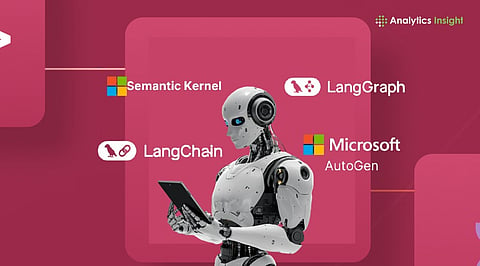
.png)

LangGraph currently leads advanced AI workflow development with strong memory and execution control.
CrewAI and AutoGen allow multiple AI agents to collaborate for complex task completion.
Enterprise adoption is rising fast as companies like Cisco Systems deploy AI agents at large scale.
Artificial intelligence has entered a new phase. AI systems previously worked like chatbots, answering questions and following simple commands. However, the recent models have become far more advanced. Modern AI agents can make decisions, solve problems, use external tools, remember past tasks, and complete complex work with little human help.
This major shift has pushed developers and companies to look for powerful frameworks for building reliable AI agents. An AI agent framework acts like a foundation that helps manage memory, task execution, reasoning, planning, and communication with other software. Choosing the right framework is now one of the most important parts of building fast and efficient AI systems.
LangGraph has become one of the most popular frameworks for building advanced AI agents. It was created by the team behind LangChain and has quickly become a strong choice for production-level AI systems.
The biggest strength of LangGraph is its ability to let AI agents remember previous steps while handling long and complex tasks. This makes it useful for research assistants, coding tools, customer support systems, and enterprise AI applications.
The framework also gives better control over how an AI system moves from one step to another. Recent industry comparisons place LangGraph among the top frameworks for its reliability and better error handling in large-scale AI projects.
CrewAI focuses on a different idea. Instead of a single AI agent doing all the work, this framework allows several AI agents to work together as a team. Each agent can take a separate role and focus on a specific task.
For example, one agent can collect information, another can check facts, while another can make final decisions. This creates better task division and often leads to stronger results. By 2026, CrewAI has gained huge popularity among startups and technology companies because it is lightweight, flexible, and easy to use with Python-based systems.
AutoGen, created by Microsoft Research, has become an important framework for systems where multiple AI agents need to communicate with each other.
The framework allows agents to exchange messages, share information, solve problems together, and work through complex tasks step by step. This makes it useful for software development assistants, automated coding systems, debugging tools, and advanced research systems.
Its flexible structure also makes connection with external APIs and other software systems much easier for developers who need highly autonomous AI systems.
Also Read - 10 AI Businesses Nobody is Talking About (Yet) in 2026
Microsoft introduced a new framework in 2026 called Microsoft Agent Framework. It acts as the next major step after earlier tools like AutoGen and Semantic Kernel.
This framework focuses strongly on enterprise-level AI development. It offers better workflow control, system monitoring, memory storage, security controls, and human approval systems whenever important decisions need supervision.
Large companies have started showing strong interest because this framework fits better inside regulated business environments where security and compliance remain important.
Semantic Kernel remains one of the strongest options for companies that need AI systems connected with internal business software. The framework makes it easier for AI agents to access databases, cloud platforms, APIs, enterprise software, and business workflows.
It works especially well for organizations that already depend heavily on Microsoft Azure services. For internal company assistants and business automation systems, Semantic Kernel continues to remain highly valuable for its strong enterprise compatibility.
LlamaIndex focuses on AI systems that depend heavily on large amounts of information. It helps AI agents search through documents, databases, PDFs, company records, and private knowledge libraries.
This framework performs extremely well when an AI agent needs accurate information before making decisions. Research assistants, enterprise search tools, legal document analyzers, and data-heavy AI systems often rely on this framework.
As businesses continue to store large amounts of digital information, frameworks like LlamaIndex have become more important than ever.
Parloa has carved out a unique position in the AI agent landscape by specializing in enterprise-level customer service automation. Unlike general-purpose frameworks, Parloa provides a comprehensive platform that combines a low-code workflow builder with powerful developer tools, specifically optimized for high-performance voice and chat interactions.
The platform’s strength lies in its ability to handle complex customer journeys with autonomous reasoning, allowing businesses to scale their support operations while maintaining a personal touch. By 2026, Parloa has become a leading choice for European enterprises seeking to deploy context-aware AI agents that integrate deeply with existing contact center infrastructure and CRM systems, reducing wait times and improving overall customer satisfaction.
The AI industry has now moved beyond simple chatbot technology. Experts across the technology sector describe 2026 as the beginning of the AI agent era.
A major example came from Cisco. The company recently announced plans to introduce AI agents across its workforce of 90,000 employees starting in August 2026. This has become one of the largest enterprise AI rollouts seen anywhere in the world so far.
Another major development came from Meta Platforms. Mark Zuckerberg recently admitted that advanced AI agent development has turned out far more difficult than expected, even after large investments in AI infrastructure.
At the same time, Anthropic launched Claude Sonnet 5, which many experts now describe as one of the strongest AI systems built specifically for autonomous agent tasks. This launch shows how the industry focus has shifted from simple chatbot conversations toward fully autonomous execution systems.
Also Read - What to Know Before Linking Your Bank Account to ChatGPT
Modern AI systems now require much more than powerful language models. Success now depends on strong memory systems, smart planning, proper task execution, reasoning ability, external tool access, and system reliability.
Among current frameworks, LangGraph stands out for advanced workflow control. CrewAI performs extremely well for multi-agent teamwork. Microsoft Agent Framework and Semantic Kernel continue to attract enterprise companies, while LlamaIndex remains highly useful for knowledge-heavy AI systems.
As the technology sector moves away from traditional chatbots, AI agent frameworks have started becoming the core foundation for the next generation of intelligent software.
1. What is an AI agent framework?
An AI agent framework is a software foundation that helps create AI systems capable of reasoning, planning, memory management, and task execution.
2. Which AI agent framework is best in 2026?
LangGraph is currently one of the strongest choices for advanced production-level AI agents.
3. Why are companies using AI agents instead of chatbots?
AI agents can make decisions, complete tasks independently, and interact with external tools, unlike traditional chatbots that mainly answer questions.
4. What framework works best for multi-agent collaboration?
CrewAI is widely known for allowing multiple AI agents to work together on complex tasks.
5. Why is AI agent technology growing so fast?
Large companies such as Meta Platforms and Cisco Systems continue investing heavily as autonomous AI systems become the future of intelligent software.
