.png)

True HEPA H13 filtration, CADR, and room coverage emerge as the key factors that determine how effectively an air purifier removes PM2.5, dust, pollen, and other indoor pollutants.
Premium, value, smart, bedroom, and compact air purifiers differ in airflow, filter longevity, maintenance costs, and after-sales support, making each better suited to specific room sizes and budgets.
Long-term ownership depends on more than the purchase price, with filter replacement costs, service availability, and proper sizing having a greater impact on overall value than marketing features.
The biggest air quality problem in Indian homes rarely gets noticed. Windows stay shut for hours, sometimes days, yet PM2.5 and fine dust keep floating around the room, settling on shelves, drifting back into the air with every fan turn. Ventilation alone cannot fix this. Filtration has to do the real work, and among filtration types, True HEPA H13 remains the one that actually removes particles this small consistently and without gaps.
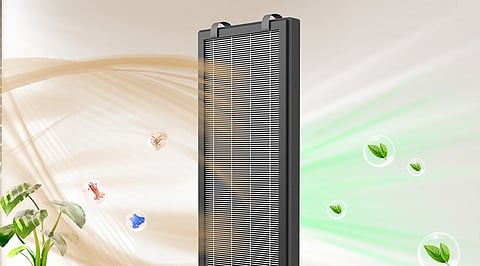
A true HEPA H13 filter traps at least 99.95% of particles down to 0.3 microns, tested under EN1822 and ISO 29463. That covers most of the PM2.5, dust, and pollen floating around Indian homes. Watch out for anything labelled HEPA-type. It sounds similar but has no real filtration standard behind it, so performance can vary a lot.
Two numbers matter more than the rest: CADR and room coverage. CADR, or Clean Air Delivery Rate, shows how fast a purifier actually cleans the air. A high CADR only helps when it suits the room size. Buy too big, and the extra power goes to waste. Buy too small, and the air takes longer to clear.
The cost doesn't end at the purchase. Filters often turn into a real expense over time. Before buying, it's worth checking how often they need replacing, what they cost, and whether they're easy to find.
Dyson does not publish AHAM CADR ratings. Instead, purification gets tested through its own POLAR methodology across an 81-cubic-meter room, a method the brand argues reflects better airflow than a chamber test.
The TP07 uses a fully sealed HEPA H13 filter, classified under EN1822 and ISO 29463, so pollutants captured inside stay inside rather than leaking through gaps elsewhere in the machine. It also cools the room and connects to the MyDyson app for scheduling and live air quality data. This unit fits buyers who want sensors, build quality, and design polish alongside filtration.
Coway trades smart features for filter longevity. The True HEPA H13 filter lasts up to 8,500 hours, close to two years under typical use, well past the 6- to 12-month cycle most competitors need. Coverage runs to 355 sq ft, suited to a medium bedroom or study, and the unit needs almost no ongoing attention once installed. Reliability wins out over app control here.
The V3 covers 465 sq ft through a 3-stage True HEPA H13 system, backed by wide India-based service support, a factor that carries real weight once something goes wrong with an imported brand. It sits mid-range within Honeywell's lineup, ahead of the V1 and V2 on coverage but without the WiFi and voice control found on the V5. Dependable filtration without smart-home extras sums up its appeal.
A CADR of 460 m³/h and coverage up to 700 sq ft make the R700 suited to large living rooms and open-plan spaces. Its 4-layer filtration includes True HEPA H13 and a nano-silver coating, paired with an app running QSensAI mode, which adjusts fan speed automatically as pollution levels change. Against the Dyson, it delivers a far higher CADR for roughly half the price, though it skips the sealed-filter design and cooling function.
Built for bedroom use, this compact unit runs a CADR of 250 m³/h across 300 sq ft, with a real-time AQI display and a 20.5 dB sleep mode quieter than most fans. The filter costs Rs. 2,370 and lasts about a year. Philips positions this as a personal purifier rather than a whole-room solution, and that focus shows in its quiet, compact build.
The strongest India-specific pick on this list, backed by a wide service network from a brand operating in the country for over four decades. Its CADR of 355 m³/h carries AHAM testing, and 480 sq ft coverage suits most Indian living rooms and larger bedrooms. Where Qubo leans on smart features, Eureka Forbes leans on local after-sales support, a real advantage when filters need replacing during peak pollution season.
At 183 sq ft coverage, this functions as a desk or personal-space unit rather than a full-room purifier and works well as an air purifier for allergies in tight settings like a study or hostel room. A 7W motor keeps it running as quietly as 25 dB, and an aroma pad for essential oils sets it apart from every other unit on this list. It fills a gap none of the larger purifiers can: a small, quiet, affordable option for a desk, dorm, or child's corner.
The room decides the purifier, not the brand name. A 700 sq ft living room calls for the Qubo R700 or Eureka Forbes 355, not the Levoit Core Mini. A bedroom under 300 sq ft suits the Philips AC0920 or Coway Airmega 150 well.
Filter cost concerns point toward the Coway, whose 8,500-hour filter life outlasts everything else on this list by a wide margin. After-sales support concerns point toward Eureka Forbes and Honeywell, both running India-based service networks that imported brands cannot easily match.
Choosing by price alone, without checking CADR against room size
Ignoring filter replacement cost until the first change comes due
Picking ‘HEPA-type’ over certified True HEPA H13
Oversizing or undersizing the purifier for its intended room
Skipping pre-filter cleaning: a wash or vacuum every two to four weeks protects airflow and extends HEPA filter life
Expecting one purifier to clean an entire home instead of the single room it is rated for
Air purifier shopping in India is shifting from a luxury decision to a routine one, as pollution seasons stretch longer each year and city air quality data becomes harder to ignore. The purifiers that will matter most going forward are not the ones with the flashiest displays but the ones with transparent CADR figures, honest filter costs, and service networks built for Indian conditions. That shift already favors brands willing to publish real numbers over marketing claims.
The best air purifier depends on your room size, budget, and air quality needs. Look for a model with a True HEPA or HEPA H13 filter, suitable CADR, and coverage that matches your room.
Yes. A True HEPA filter is designed to capture at least 99.97% of particles measuring 0.3 microns, making it more effective against PM2.5, dust, pollen, and allergens than HEPA-type filters.
Match the purifier's recommended coverage area and CADR to your room size. A unit with adequate airflow cleans the air more efficiently and maintains better indoor air quality.
Most HEPA filters last between 6 and 12 months, depending on usage and local pollution levels. Homes in cities with higher PM2.5 and dust may require more frequent filter replacements.
Yes. A True HEPA air purifier can reduce airborne allergens such as dust, pollen, and pet dander, helping improve indoor air quality. It should complement, not replace, medical advice or prescribed treatment for allergies or asthma.
