.png)

At Matrix, Krish Mendapara is helping develop a diagnostic platform designed around a small blood sample, a disposable test strip, and a smartphone image, with the technology now evaluated across clinical samples.
Repeated blood testing can create added cost, logistics, and days of waiting for patients who need measurements more than once. Krish Mendapara is working on a different model. As co-founder and CTO of Matrix, he is helping develop a testing platform designed so that a person can collect a small blood sample, add it to a disposable test strip, wait about 15 minutes, and use a smartphone image as part of the readout process. The company has now evaluated its latest assay on 100 clinical samples.
The significance of that milestone is not simply that Matrix is trying to shrink laboratory testing into a smaller format. Mendapara’s work sits at the intersection of assay development, software, and product design, which means the test has to function as more than a laboratory experiment. It has to fit into a healthcare workflow where the timing of the result, the way the sample is collected, and the usefulness of the information all matter.
“A test can be scientifically interesting and still be a bad product if the patient cannot use it easily or the result does not arrive when it is useful,” Mendapara said. “The measurement is only one part of the problem.”
That distinction has shaped Matrix’s early development. The company is starting with areas where blood testing is already recurring rather than occasional. Hormone care is one example. Patients receiving treatment may need repeated tests, each one adding cost, logistics, and days of waiting. Matrix is being designed around the possibility of moving more of that process into the home while still returning information to the patient’s clinic.
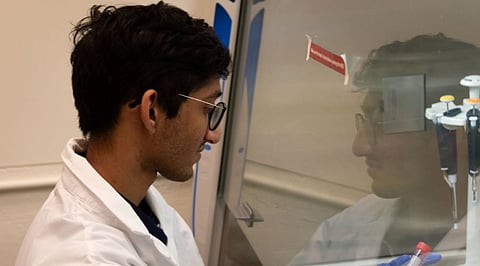
The current platform is intended to use a small blood sample applied to a disposable strip, followed by a short waiting period and smartphone-based analysis. Mendapara’s role spans the scientific, software, and product components behind that system. He personally worked on the assay chemistry with Matrix’s research and development partner, identifying antibodies, completing validation studies, and designing experiments. He also conducted market research and validation by speaking with clinics, bringing feedback from potential users into the development process.
Matrix has evaluated cortisol, DHEA-S, and testosterone assays in both saliva and serum. According to the company's testing, the technology has measured testosterone at concentrations as low as 20 pg/mL, with an average signal coefficient of variation below 4 percent. The company also reports that its smartphone reader software achieved high sensitivity and specificity for signal detection.
For Mendapara, the broader problem in diagnostics is that accuracy alone does not determine whether a test is useful. He points to the surrounding workflow: how the sample is collected, how often the test can realistically be repeated, how quickly the result reaches the patient or clinician, and whether the economics make sense when testing needs to happen several times a year instead of once.
“Accuracy is non-negotiable, but it does not answer every question,” Mendapara said. “You also have to ask whether someone can repeat the test when they need it and whether the information gets back to the person making the clinical decision in time to matter.”
That framing is especially relevant in areas where treatment decisions depend on repeated biomarker measurements. Matrix identifies hormone therapy as an early use case, with potential future applications in thyroid care, fertility, metabolic health, cardiovascular risk, kidney health, and diabetes. Those later categories remain future directions rather than completed product areas, but they reflect the same broader idea: biological measurements may become more useful when they can be obtained more frequently and with less friction.
Matrix’s tests remain under development and are not FDA-cleared or currently available for clinical use. The company is bringing clinics on as early partners to help shape assay development and clinical capabilities. Its men’s and women’s hormone assays are targeted for completion in 2027. After that, Matrix plans to pursue FDA clearance for professional point-of-care use and at-home consumer use.
That status places the company’s current work firmly in the development and validation stage. Mendapara’s contribution extends beyond creating a compact testing format. His work connects assay chemistry, validation, software, product decisions, and feedback from clinics as Matrix works toward a system intended to move biological measurement closer to the patient while remaining useful within a clinical context.
Matrix’s work also reflects a broader shift in consumer health. Wearables have made frequent measurement familiar for signals such as heart rate, sleep, and activity, while blood testing remains tied more closely to conventional laboratory workflows. Mendapara sees that gap as one reason biochemical measurement is still less frequent and less accessible than many other forms of personal health data.
His focus, however, is narrower than replacing laboratory medicine. The immediate technical challenge is to develop a platform that can make specific biomarker measurements faster and easier to access while preserving the rigor required for healthcare use.
“We want the test to fit into someone’s life without making the science weaker,” Mendapara said. “If you can make the measurement easier to repeat and still produce reliable information, that changes what becomes possible around the test.”
Matrix has moved its at-home testing concept beyond an early prototype by evaluating assays across clinical samples and quantifying performance in both the chemistry and smartphone-based readout. Mendapara’s role as CTO spans the scientific, software, and product work behind that progress. The challenge now is to carry those results through continued validation and the regulatory process required before the tests can move into clinical use.