.png)

Ceramic heating technology uses an engineered porous material to move oil toward a heating element and distribute heat across a controlled area. In modern vape hardware, however, “ceramic” is not a complete performance specification. Results also depend on pore structure, coil geometry, electrical power, airflow, oil viscosity and the way every component is assembled.
The category is therefore moving beyond the idea of one universal ceramic coil. The more important trend is application-specific engineering: different materials and heating structures designed around different formulations, capacities and device formats.
A ceramic vape coil is a system of porous material, electrical heating, liquid delivery and airflow—not a single interchangeable part.
Pore structure influences how quickly oil reaches the heating area, while thermal properties affect how evenly heat spreads.
Different oil profiles can require different inlet, ceramic, power and airflow parameters.
Postless designs change the internal architecture but still require complete-device testing.
B2B buyers should validate hardware with the exact formulation, filling process and storage conditions intended for launch.
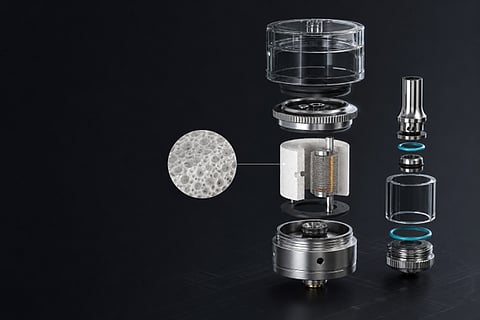
A ceramic heating system usually combines a porous ceramic body with an embedded, wrapped or surface-mounted conductive element. When electrical power reaches the element, heat moves through the ceramic and into the oil held near its surface. The pores also support capillary movement, helping replenish oil at the heating area.
This dual role—liquid transport and heat distribution—is why ceramic has become important in compact vaporizer hardware. Metal coils and cotton-based structures can also vaporize oil, but engineered ceramic creates additional options for controlling pore size, shape, heating area and material contact.
The word “ceramic” still covers a broad range of constructions. Two cores may look similar while using different formulations, densities, coil materials or heating geometries. Buyers should therefore examine how a core is designed for its application rather than treating the material name as proof of a specific outcome.
Oil formulations differ in viscosity, composition and temperature sensitivity. A system that supplies a relatively fluid distillate at an appropriate rate may not feed a thicker rosin in the same way. Increasing power to compensate can create new problems if the oil cannot reach the heating area quickly enough.
Capacity also matters. Hardware designed for a smaller reservoir may experience a different operating pattern from a high-capacity device used for longer sessions. Heat can accumulate, the oil level changes over time and the distance between the remaining material and the inlet may become more important.
A universal core must compromise across these conditions. Application-specific hardware can instead tune several variables together:
pore size and distribution;
oil-inlet geometry;
coil material and shape;
active heating area;
voltage, resistance and power;
airflow and activation behavior; and
reservoir structure and capacity.
The objective is not to maximize any one specification. It is to keep liquid delivery, heat generation and airflow in balance across the intended operating range.
The ceramic body performs more than one task, and three material characteristics are especially important.
Interconnected pores allow oil to move through the ceramic toward the heated surface. If the structure supplies oil too slowly for the power and usage pattern, the heating area can become under-supplied. If liquid movement is too aggressive for the device architecture, the system may become more difficult to control during storage or between activations.
Pore size is therefore not simply “larger is better.” Engineers consider the distribution and connectivity of pores as well as the target formulation. The ideal structure is application dependent.
Thermal conductivity and heat capacity influence how quickly the core warms and how heat spreads. Localized hot spots can expose a small area to disproportionate thermal load, while a more controlled distribution can use the available surface more effectively.
The surrounding hardware also affects thermal behavior. The center structure, tank, seals and enclosure can absorb or retain heat. A core cannot be evaluated independently from the complete device.
Porosity creates liquid pathways, but it can also influence material strength. A core must tolerate manufacturing, assembly, shipping and normal operation without cracking. Ceramic formulation, firing conditions, geometry and handling procedures all contribute to mechanical reliability.
This creates a classic materials-engineering tradeoff: the pore network must support the formulation while the structure remains suitable for repeatable production.
The conductive element determines where electrical energy becomes heat. Traditional spiral patterns, mesh structures and multi-zone layouts produce different heat maps. The choice affects warm-up behavior, active surface area and the concentration of thermal energy.
A larger heating area can spread energy, but it also changes power requirements. A fast-heating structure may improve response, yet it must remain synchronized with liquid supply. Multi-zone concepts can create areas that operate at different thermal intensities, helping engineers manage both vapor generation and temperature-sensitive components of a formulation.
For buyers, the relevant question is not which geometry sounds most advanced. It is whether the supplier can explain why a particular geometry, resistance and power profile were selected for the intended oil and device capacity.
The following framework illustrates why formulation matching belongs early in development.
These categories are not fixed engineering standards, and formulations within them can vary. The table is a starting point for sample selection, not a substitute for validation.
Traditional cartridge and all-in-one structures often use a center post as part of the airflow, electrical or structural system. A postless design changes that internal architecture, potentially opening more reservoir space and reducing some direct contact between oil and conventional center components.
Postless construction can also support different visual proportions and transparent-window designs. From an engineering perspective, however, removing a post transfers its functions elsewhere. Airflow still needs a controlled path, electrical connections must remain stable and the assembly must maintain structural integrity.
The term should therefore be treated as an architectural description, not a universal quality guarantee. Materials, seals, airflow and production tolerances still determine the behavior of the complete device.
The most meaningful innovation is the shift from selling a generic core to developing a portfolio around distinct use cases. A technology platform can vary ceramic formulation, coil architecture, heating zones and surrounding hardware while preserving a repeatable development and manufacturing process.
The public portfolio of CILICON ceramic heating technology demonstrates this application-specific direction. It presents separate technology families for premium oils, rosin, high-capacity formats, cost-sensitive scale and dabbing applications. The strategic point is not that one platform is universally superior; it is that hardware can be selected around the formulation and commercial objective.
For brands, this can create a clearer sourcing process. Instead of choosing an attractive device and then trying to make every oil work inside it, the team begins with formulation data, expected capacity, activation and experience targets. The supplier can then recommend an existing platform or identify where customization and additional validation are necessary.
A responsible qualification plan should include more than a short activation check. Buyers can use the following sequence:
Define the formulation: Record viscosity or other available physical data, target fill volume and filling temperature.
Confirm the configuration: Document the core, inlet, resistance, battery, voltage, airflow and reservoir selected for the sample.
Run a controlled filling trial: Use the intended production method, headspace and closure process.
Condition the samples: Allow filled units to stabilize for a defined period before evaluation.
Test multiple orientations: Include upright, horizontal and any transport-relevant positions.
Evaluate environmental conditions: Use realistic temperature, storage and shipping scenarios for the destination market.
Compare multiple units: Look for distributions and outliers rather than relying on one sample.
Repeat after changes: A new oil batch, inlet, core, battery or enclosure may require partial or complete revalidation.
Acceptance criteria should be written before the test begins. Useful observations can include activation consistency, airflow, visible leakage, blockage, residual material and changes after storage. Any laboratory measurements should use documented methods.
The next phase is likely to bring greater specialization rather than one dominant core. Engineers can tune pore structures for defined viscosity ranges, use more deliberate heating maps and connect the core more closely with airflow and power control. Digital simulation and manufacturing data may help narrow prototypes and identify production drift, but physical formulation testing will remain essential.
Material efficiency will also matter. Designers will face pressure to reduce unnecessary parts, improve assembly consistency and communicate disposal responsibilities for devices that combine batteries, electronics and mixed materials.
Ceramic heating is therefore becoming a platform discipline. Competitive advantage will come from understanding the relationship between material science and the complete product—not from placing the word “ceramic” on a specification sheet. CILICON continues to develop ceramic heating technology around formulation-specific requirements, device architecture and complete-system performance.
It is a heating component that uses engineered ceramic—often porous—to support oil transport and distribute heat from an electrical element. Its behavior depends on the ceramic, coil, power, airflow and formulation.
No. Ceramic composition, pore structure, coil geometry, resistance, active area and surrounding hardware can differ substantially.
Viscosity affects how quickly oil moves through inlets and porous material. The supply rate must remain coordinated with the amount of heat and the device’s operating pattern.
It is an architecture that removes the conventional center post from the reservoir area and redistributes its airflow, electrical or structural functions elsewhere in the device.
No. Additional power can create more heat, but the formulation, liquid supply, heating area, airflow and materials must support it. Balanced engineering is more important than a single maximum value.
They should use the same formulation, filling procedure, conditioning period, storage conditions and documented evaluation criteria across multiple units.
