.png)

Apple’s rumored home display could serve as a central control point for smart home devices.
Siri AI could make household commands more natural and useful.
Personal profiles, widgets, and presence detection could create a more tailored home experience.
Apple’s rumored smart home display now looks far more serious than an old product idea. Recent software leaks point to a device with the codename J490, while a second version, J491, may support wall mounting. Reports place the launch before the end of 2026, with October now a strong possibility. Apple has also started retail changes that may make room for new home products.
The product may carry the name Home Hub or HomePod, although Apple has not confirmed a public name. Reports point to a square seven-inch screen, a front camera, a speaker base for the desk version, and a separate wall model. A price near USD 350 has also appeared in several reports.
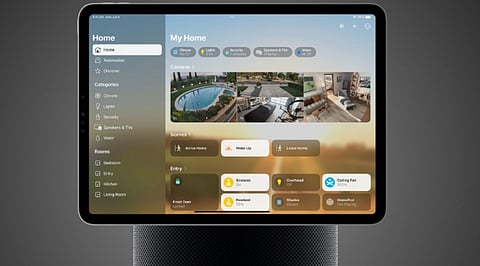
The main value may not come from the screen itself. Apple appears to want this device to act as the main control point for the home. The display could show the time, weather, calendar details, photos, music controls, Home controls, and other useful information.
The device may also support Safari, Apple News, Apple Music, Notes, Calendar, Photos, and Home. Reports do not expect a separate App Store, which suggests a simpler system than an iPad. Instead, widgets may provide much of the daily information.
That approach could give the Home Hub a clear purpose. An iPad offers far more features, yet an iPad does not always feel like a permanent part of a house. Apple’s rumored device could sit on a kitchen counter or wall and serve as a fixed home control point.
Siri remains the most important part of the story. Apple introduced a new Siri AI in June 2026 with personal context, broad web knowledge, onscreen awareness, and stronger app actions. Siri AI can search across messages, emails, photos, and other personal data, then help with tasks across supported apps.
That capability fits a home hub far better than the older Siri experience. A smart display needs more than simple commands such as turning lights on or setting a timer. A stronger Siri could handle requests that involve several parts of a home routine.
A request such as a night routine could involve lights, temperature, music, locks, and other Home devices. The value would come from one natural request rather than several separate controls.
Apple’s history of delays also shows how important Siri has become to this product. The Home Hub first faced a launch target in 2025, then moved into 2026. Reports linked those delays to the readiness of the new Siri.
Also Read - 25 Apple Intelligence Features Every iPhone User Should Know About
Apple may also give the display a level of personal awareness that many smart screens lack. Reports point to facial recognition, presence detection, and support for several household profiles.
That could let the same device show different information for different people. A family member could see personal calendar details, reminders, photos, or other content after the system identifies that person.
Recent macOS code also points to ambient sensing. The display may react to distance and presence, with more information available when a person stands close to the screen.
Privacy will matter here. Reports say personal widget data may stay hidden unless the linked primary device sits inside the home. That approach would help Apple balance personal features with the shared nature of a household screen.
A recent macOS leak offers another important clue. Code tied to J490 points to a Widget Gallery, Smart Stack support, clock faces, and possible support for widgets from a linked iPhone.
That means the Home Hub may work less like a small tablet and more like an Apple Watch for the house. A household could select the information that matters most, while Smart Stack could rotate useful widgets through the day.
This model also gives Apple a simple way to keep the interface focused. Instead of turning the home into another app marketplace, Apple can make the screen a place for quick information and direct control.
Also Read - Apple Unveils macOS Golden Gate, iPadOS 27 With AI-Powered Upgrades
The Home Hub may only form one part of a wider Apple home push. Reports also point to a new HomePod mini, a new Apple TV, a possible security camera, and later products such as a video doorbell and a tabletop robot.
That larger plan matters. A single smart display would add another Apple accessory. A group of connected home products could create a complete Apple home platform. The Home Hub could sit at the center while cameras, speakers, televisions, locks, lights, and other devices connect around it.
The real test will come from Siri. A USD 350 smart display faces cheaper rivals, so Apple needs more than attractive hardware. The product needs to make a home feel easier to control.
If Apple combines a simple screen, personal profiles, strong Home controls, useful widgets, and reliable Siri AI, the Home Hub may become more than another smart speaker. It could give Apple the missing central interface for the modern home, with one screen that makes the entire house feel like one connected system.
1. What is Apple’s rumored smart home display?
Apple’s rumored smart home display is a new home-focused device with a screen, Siri AI, and Apple Home controls.
2. What size could the Apple smart home display have?
Reports suggest a square display of around seven inches.
3. What could Siri AI do on the device?
Siri AI could handle home commands, access personal information, and perform more complex tasks across supported Apple services.
4. Could the device support multiple household members?
Yes. Reports point to personal profiles, facial recognition, and presence detection for different household members.
5. When could Apple launch the smart home display?
Current reports point to a launch before the end of 2026, with October among the possible release windows.
