.png)

Most consumer robotics products compete on a spec sheet. More suction, longer battery, a bigger number somewhere. The interesting ones compete on architecture, on decisions made early in the design that are hard for competitors to copy later. In the fast-moving world of autonomous outdoor robotics, the companies building a real technical moat are the ones that got the architecture right, and the modular yard robot is turning into a useful case study in what that actually means.
The outdoor environment punishes shortcuts. Unlike an indoor robot working on flat, predictable floors, an outdoor autonomous system has to solve localization, perception, traction, and task execution simultaneously, in weather, on slopes, across acres. Getting any one of these wrong makes the product unusable. Getting all of them right, in a way that's also economically sensible for a homeowner, is the genuine engineering challenge. Here's how the leading approach tackles it.
The first hard problem is knowing exactly where the robot is. For an outdoor machine operating without buried boundary wires, positioning has to come from somewhere else, and the somewhere else is usually satellite navigation. But standard GPS, accurate to several meters, is useless when a few inches of error means driving over a flowerbed or off a retaining wall.
The answer the industry has converged on is RTK-GPS, or Real-Time Kinematic GPS, which uses a fixed base station to correct satellite positioning down to centimetre-level accuracy. That precision is what makes wire-free navigation viable at all. It's the difference between "somewhere in the yard" and "exactly on the mowing line."
But RTK-GPS has obvious drawbacks. Under tree cover, near buildings, or anywhere the sky is obstructed, satellite signal degrades or drops entirely. A system that relies on RTK-GPS alone becomes unreliable exactly where many real yards are most complex. This is the point where architecture separates the serious products from the rest.
The robust solution is not a single better sensor. It's fusing multiple sensing systems so that the weaknesses of each are covered by the strengths of the others. This is the approach behind Yarbo and its multi-sensor fusion system, which the company calls PPVS.
PPVS combines RTK-GPS with dual vision cameras and onboard sensors, blending RTK, vision, odometer, collision bar, IMU, and LiDAR (the presence of LiDAR varies by series and version model) into a single continuously updated estimate of where the robot is and what's around it. When satellite signal drops under a tree canopy, vision and onboard sensing carry the localization load until the signal returns. When vision is challenged by low light or glare, satellite positioning anchors the estimate. The fused system stays reliable in conditions that would break any single sensor working alone.
This is the kind of engineering that constitutes a real moat, because sensor fusion is genuinely hard to get right. It isn't a component you can buy off a shelf and bolt on. It's the accumulated result of tuning how different data streams are weighted, reconciled, and trusted in thousands of edge cases across real terrain. Competitors can buy the same GPS chips and the same cameras. What they can't easily copy is the fusion logic that makes them work together reliably.
Perception and localization mean nothing if the robot can't physically go where it needs to. This is where the mechanical architecture matters. Many robotic mowers use wheels, which struggle on slopes and slick or uneven ground. The modular yard robot approach uses tracked mobility instead, distributing weight and gripping terrain in a way that lets the machine handle steep grades and heavy loads.
500 lbs Towing Capacity
The engineering payoff is substantial. Yarbo's tracked core is rated for slopes as steep as 70 percent and coverage measured in multiple acres, territory that would defeat a conventional wheeled robotic mower. Tracks also matter enormously for the winter use case, where a robotic snow blower has to push through accumulation and maintain traction on surfaces a wheeled machine would simply slip on.
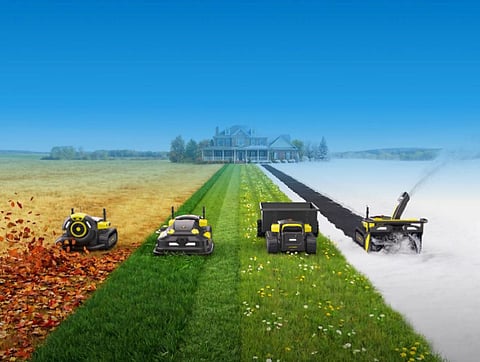
The final and most distinctive architectural decision is modularity. Rather than building separate robots for separate jobs, the design centers on one intelligent, autonomous core that accepts interchangeable modules. The same core becomes a robot lawn mower, a snow blower, a leaf blower, or a trimmer depending on which module is attached.
From an engineering standpoint, this is an elegant separation of concerns. The expensive, complex, high-value parts, the navigation stack, the sensor fusion system, the battery platform, the traction system, live in the core and get reused across every task. The modules handle the mechanical specifics of each job. This means the hard-won intelligence is amortized across many functions rather than duplicated in four separate machines, which is both better engineering and better economics.
It also creates a compounding advantage. Every improvement to the core's AI and navigation benefits every module simultaneously. A software update that sharpens obstacle detection makes the mower, the snow blower, and every other configuration smarter at once. That's a platform dynamic, not a product one, and platforms are notoriously difficult for single-product competitors to catch.
Step back and the pattern is clear. The moat here isn't any individual feature. It's the combination of centimeter-accurate fused localization, terrain-capable tracked mobility, and a modular core that turns one hard-won intelligent platform into a year-round fleet of functions. Each of those is difficult on its own. Integrated into a coherent whole that a homeowner can actually operate, they represent exactly the kind of architectural depth that's hard to replicate and slow to erode.
In autonomous outdoor robotics, the spec sheet is the surface. The architecture is the product.
