.png)

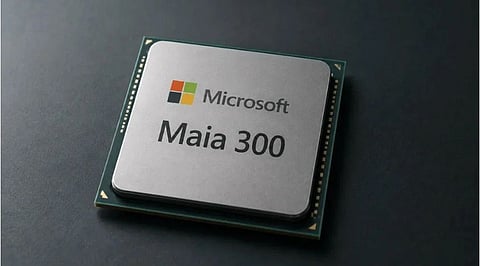
Microsoft is preparing to unveil its next-generation Maia 300 AI accelerator as early as September, marking another step in its effort to build its own AI infrastructure and reduce reliance on NVIDIA processors. The move comes as demand for computing power rises with the growth of generative AI, cloud services and AI agents.
Sources close to the company say Microsoft is negotiating with Taiwan Semiconductor Manufacturing Co. (TSMC) to secure production capacity to produce more than 300,000 Maia 300 chips by 2027. The company could eventually scale the program to more than one million chips. Microsoft has not confirmed the production quantities, saying its custom silicon program is being conducted at significantly large volumes.
Microsoft introduced its first Maia accelerator in 2023 and unveiled Maia 200 in January 2026. Production of the Maia 200 has reportedly remained in the tens of thousands, making the Maia 300 an effort to move the program towards substantially larger-scale deployment.
The new accelerator is expected to power large AI workloads across Microsoft Azure, with a strong focus on AI inference. Microsoft also wants its custom silicon to handle workloads from its own AI services and from models developed by OpenAI, potentially lowering inference costs at Azure scale.
Microsoft has not disclosed the final specifications or performance figures for Maia 300. The company has also not released details on its benchmarks, memory capacity, or manufacturing process.
Also Read: How AI Is Keeping Microsoft's China Business Alive
Maia 200, meanwhile, is built using a 3-nanometre process and features 216GB of HBM3e memory, 7TB/s of memory bandwidth and 272MB of on-die SRAM. Its networking architecture can connect up to 6,144 accelerators.
Microsoft says the Maia 200 delivers more than 10 petaFLOPS at FP4 precision and more than 5 petaFLOPS at FP8 precision. The company has also claimed 30% better performance per dollar than the latest-generation hardware in its existing fleet.
Microsoft is not necessarily looking to replace NVIDIA across every AI workload. Instead, Maia could be used for tasks that Microsoft can optimize for its own software and cloud infrastructure, while NVIDIA accelerators remain available for workloads where they offer an advantage.
Microsoft has said Maia 200 delivers 40% better performance per watt for MAI models and supports both OpenAI and Microsoft AI workloads. The company is also reportedly seeking to persuade major cloud customers, including Anthropic, to use Maia.
The success of Maia 300 will ultimately depend on its performance, cost, energy efficiency, software compatibility, and availability. Its architecture, manufacturing process, memory configuration, benchmarks, and pricing remain unanswered.
