.png)

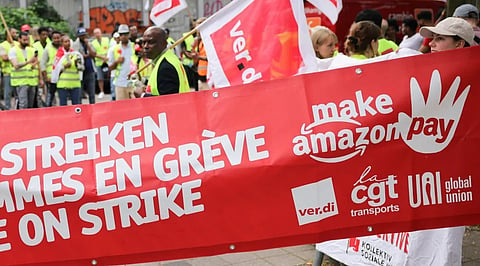
Amazon workers and their supporters are preparing strikes and protests across more than 20 countries during the Black Friday and Cyber Monday shopping period, demanding better wages, safer working conditions and recognition of trade unions. The demonstrations are part of the annual Make Amazon Pay campaign, now in its seventh year.
Organized by UNI Global Union and Progressive International, the campaign aims to pressure the e-commerce giant to negotiate with unions and respect employees’ right to organize.
German trade union Verdi has called strikes at 11 Amazon locations on Friday, November 27, coinciding with Black Friday. The union claims Amazon’s wages are often insufficient for workers to cover living expenses. It has also raised concerns about the physical demands of warehouse work.
According to Deutsche Presse-Agentur, Verdi alleged that Amazon uses digital trackers to monitor around 40,000 employees. An Amazon spokesperson denied the union’s claims and said the company’s average starting pay was above Germany’s minimum wage.
In the United States, Teamsters are planning protests in Los Angeles and Chicago on Cyber Monday, November 30. Workers and supporters are also expected to mobilize in Canada, Australia, India, Bangladesh, Poland, Luxembourg, Brazil, Colombia, Uruguay, Indonesia, Japan, the Philippines, Thailand, Fiji, Singapore and South Africa.
Responding to the planned demonstrations, an Amazon spokesperson said the company provides competitive pay, benefits and career opportunities from the first day of employment. The company also said it directly employs more than 1.5 million people worldwide and offers a modern, safe, and engaging workplace across its offices and operational facilities.
The protests come as Amazon faces growing pressure from labor groups seeking stronger collective bargaining rights.
Also Read: Amazon May Finally Let Meta's AI Agent Muse Shop on Its Platform Again
The campaign follows a significant development earlier this month, when workers at Amazon’s warehouse in Delta, British Columbia, secured the company’s first union contract in North America.
The three-year agreement, imposed through binding arbitration, provides for hourly wages of up to 29 Canadian dollars by its conclusion, an additional week of vacation for employees with 10 years of service, and severance benefits of up to 18 weeks.
Amazon has challenged the arbitration process, while labor groups continue to push for union recognition and improved workplace protections.