.png)

Mini PCs are no longer just productivity machines. In 2026, the best mini PC for gaming delivers competitive esports-ready performance, optimized 1080p AAA gameplay, and advanced connectivity, all in an ultra-compact footprint.
Thanks to modern RDNA 3.5 graphics, improved thermal engineering, and external GPU support via USB4 compatibility, compact systems now offer serious gaming potential without the bulk of a traditional tower.
Whether you're a competitive gamer, content creator, or hybrid professional who games after hours, here are the best gaming-ready mini PCs of 2026, evaluated for performance, cooling, upgradability, and long-term value.
Best for: Premium compact gaming performance with long-term value
The GEEKOM A9 Max AI Mini PC stands at the forefront of flagship-class mini PC engineering in 2026. Designed for high-output daily workflows and serious gaming sessions alike, it blends desktop-class power with an ultra-compact footprint.
Powered by the AMD Ryzen™ AI 9 HX 370 (54W TDP) with advanced XDNA™ 2 architecture, the A9 Max delivers a combined 80 TOPS of AI performance, making it a true Copilot+ PC capable of local AI deployment, LLM workflows, and advanced multitasking. For gamers, the A9 Max integrates Radeon™ 890M graphics built on RDNA™ 3.5 architecture, delivering high-frame 1080p AAA gaming performance that rivals discrete GPUs.
Unlike compact systems that rely on short boost bursts, the A9 Max is built for sustained output. Its upgraded IceBlast 2.0 cooling system features a large copper thermal module, dual heat pipes, and active dual-fan thermal management, allowing the system to maintain consistent clock speeds under load while operating quietly. This thermal stability is critical for long gaming sessions and demanding rendering tasks alike.
Connectivity is equally future-ready. The A9 Max features dual 40Gbps USB4 ports with full eGPU support, delivering Thunderbolt-class bandwidth without requiring a dedicated OCuLink interface. For most gamers and power users, modern USB4 provides the high-speed external GPU scalability previously associated with OCuLink, while offering broader compatibility, cleaner cable management, and greater versatility for docks, storage, and display expansion.
Combined with dual HDMI 2.1 outputs, the system supports up to four 4K displays or a single 8K display, and is further enhanced by Wi-Fi 7, Bluetooth 5.4, and dual 2.5GbE LAN for ultra-fast, low-latency networking.
The result is an intelligent investment: flagship performance without the bulk, exceptional performance-to-price ratio, and upgradeable architecture for long-term relevance.
Key Features:
Flagship-class processors in an ultra-compact chassis
Radeon™ 890M graphics (RDNA™ 3.5) for high-frame 1080p AAA gaming
Optimized for 1080p AAA gaming
IceBlast 2.0 cooling with active dual-fan thermal management
Consistent clock speeds under load
Dual 40Gbps USB4 ports (eGPU-ready)
Supports up to 8K display output
Windows 11 Pro with TPM 2.0
Upgradeable, future-ready architecture
Quality-tested before shipment
Pros:
Premium compact performance
Strong sustained gaming stability
Exceptional performance-to-price ratio
Ultra-compact footprint with desktop-class power
Enterprise-ready security features
Cons:
Higher configurations increase total cost
Focused primarily on Windows ecosystem
Best for: Budget-conscious gamers entering the compact space
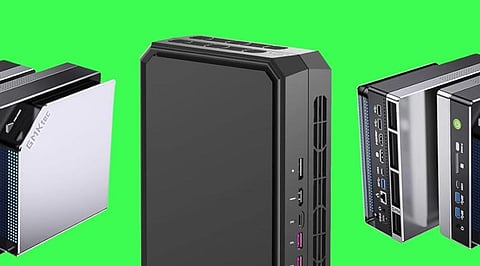
The GMKtec NucBox K8 Plus targets entry-level and mid-range gamers looking for affordable compact performance. It handles esports titles and lighter AAA games at moderate settings.
While not designed for sustained heavy loads like premium-tier systems, it offers a compact and accessible option for casual gamers or secondary gaming setups.
Key Features:
Mid-range AMD processor options
Compact and lightweight chassis
Budget-friendly pricing
Pros:
Affordable entry into mini PC gaming
Efficient power consumption
Simple plug-and-play setup
Cons:
Limited headroom for demanding AAA titles
Thermal performance varies under extended load
Best for: Balanced mid-range gaming and multitasking
The Beelink SER8 strikes a balance between price and gaming capability. It supports 1080p esports gaming comfortably and handles multitasking well, making it suitable for users who stream, browse, and game simultaneously.
Its compact metal chassis and modern processor options position it firmly in the mid-tier segment.
Key Features:
Solid AMD processor configurations
Multi-display support
Compact metal construction
Pros:
Reliable general gaming performance
Good value in mid-range segment
Quiet operation under moderate load
Cons:
Limited expansion options compared to premium competitors
Not built for high-end sustained AAA performance
Best for: Premium branded compact gaming systems
The ASUS ROG NUC Mini PC carries strong brand recognition in gaming hardware. Built with performance-focused components and gaming aesthetics, it targets enthusiasts who want a compact yet powerful branded system.
ASUS integrates premium components and tuning expertise from its ROG lineup, delivering solid gaming results in a small footprint.
Key Features:
High-performance CPU and GPU configurations
Gaming-focused thermal engineering
Strong brand ecosystem integration
Pros:
Trusted gaming brand
Strong build quality
Reliable gaming-focused design
Cons:
Premium pricing
Less flexible upgrade paths than modular competitors
Best for: Enthusiasts seeking high-end compact builds
The Minisforum AtomMan G7 Pro pushes compact gaming performance with powerful CPU and GPU configurations. Known for aggressive hardware combinations, Minisforum appeals to enthusiasts who want maximum specs in minimal space.
Its systems often deliver strong benchmark numbers and multi-display setups, though thermal consistency can vary depending on configuration and workload.
High-core-count processors
Dedicated GPU options in select models
Strong I/O and connectivity support
Excellent raw performance
Flexible configurations
Appeals to hardware enthusiasts
Premium-tier pricing
Thermal performance depends on setup
Selecting the best mini PC for gaming depends on your priorities:
Look beyond peak benchmark scores. Cooling systems like dual-fan active thermal management help maintain consistent clock speeds and stable frame rates.
Modern RDNA 3.5 graphics can handle 1080p AAA gaming. Future scalability is supported via dual USB4 ports with eGPU readiness, enabling external GPU expansion and high-bandwidth connectivity without relying on legacy OCuLink or Thunderbolt implementations.
Compact systems must manage heat efficiently. Advanced cooling solutions directly impact long-session stability.
eGPU readiness, RAM expansion, and high-speed storage support extend the lifespan of your system.
The smartest choice balances upfront cost with sustainable performance over time.
Premium compact systems with strong integrated graphics and advanced cooling provide the most consistent 1080p AAA performance.
Yes. Many modern mini PCs deliver esports-ready performance at high settings in titles like Valorant, Fortnite, and CS2.
High-end models with strong processors and efficient cooling can handle gaming and light streaming simultaneously.
For gamers planning long-term upgrades, USB4 eGPU compatibility adds meaningful future scalability. It allows a compact mini PC to transition from high-performance 1080p gaming today to more demanding 1440p or 4K experiences later, without replacing the entire system.
In 2026, the best mini PC for gaming proves that serious performance no longer requires a full-sized tower. Today’s leading compact systems deliver competitive frame rates, intelligent thermal design, and future-ready connectivity in a refined form factor.
The GEEKOM A9 Max AI Mini PC exemplifies how premium compact performance and industrial-grade reliability can coexist in a minimal footprint, offering flagship performance without the bulk. Alongside strong competitors like GMKtec, Beelink, ASUS, and Minisforum, the gaming mini PC category has fully matured.
For gamers who want power, flexibility, and space-saving design, the compact gaming era has officially arrived.
