.png)

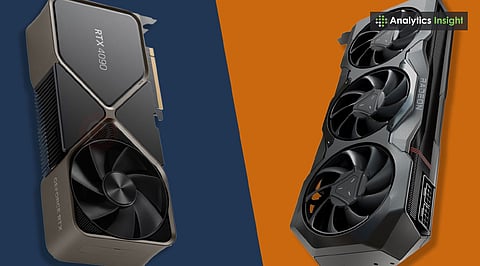
NVIDIA Graphics Cards dominate in ray tracing, AI, and 4K gaming.
AMD Graphics Cards deliver better value and more VRAM in midrange tiers.
The choice between NVIDIA vs AMD Graphics Cards depends on workload, budget, and feature priorities.
Choosing between NVIDIA and AMD graphics cards in 2026 depends on more than gaming performance. Pricing, video memory, ray tracing, AI features, and software compatibility can all influence your decision. NVIDIA's GeForce RTX 50 series and AMD's Radeon RX 9000 series offer different advantages, but neither brand is the right choice for everyone.
For Indian buyers, current retail prices also matter. A graphics card that performs slightly better may not justify a significant price difference. Here's how the two brands compare and what you should consider before buying.
NVIDIA's GeForce RTX 50 series uses the Blackwell architecture and includes models ranging from the RTX 5050 to the RTX 5090. Its strengths include ray tracing, DLSS, and support for AI and creative applications through its CUDA ecosystem.
AMD's Radeon RX 9000 series uses the RDNA 4 architecture. Models such as the RX 9060 XT, RX 9070, and RX 9070 XT compete across different gaming segments. AMD also offers FidelityFX Super Resolution (FSR), which helps improve performance in supported games.
The best choice depends on the specific models being compared, their prices, and your intended workload.
At 1080p, most modern graphics cards can run games smoothly. Competitive gamers need to concentrate on performance metrics, such as frames per second and frame consistency. For 1440p gaming, performance in demanding games, VRAM capacity, ray-tracing capabilities, and upscaling capabilities should be compared. Both AMD and NVIDIA provide cards that can be evaluated based on performance and price.
For 4K gaming, the importance of the graphics card increases. The more advanced cards from NVIDIA can be considered for demanding ray-traced games, while cards from AMD may be competitive based on performance and price.
Benchmarks should always be compared with identical games, graphics, and test settings. Performance when generating frames and native rendering performance should be distinguished because higher frames displayed do not necessarily mean higher frame generation.
NVIDIA's Deep Learning Super Sampling (DLSS) utilizes AI technology for enhanced performance in games supporting this technology. The technology provides such features as upscaling and frame generation based on the hardware. DLSS 5 technology has also become part of the graphics conversation in 2026; however, buyers must ensure hardware and game support.
FSR technology from AMD provides such features as upscaling and frame generation in selected games. The technology's FSR Redstone enhancements add to AMD's use of machine learning technology in graphics processing. Neither technology can offer similar performance in all games.
NVIDIA has a benefit in many AI applications since there are multiple development tools that are compatible with CUDA. Thus, it may be easy to use NVIDIA graphics cards for AI inference locally, training of AI models, and GPU-accelerated creative applications.
Similarly, AMD can perform many supported computing tasks using ROCm and software frameworks that are compatible with AMD. Still, compatibility depends on the specific GPU, OS, and application. VRAM is important in case of both companies. Big AI models and creative projects may require lots of memory.
The price available in India can change which graphics card offers better value. Launch prices do not always reflect current retail conditions, and availability can vary between models and retailers.
Before buying, compare current street prices, VRAM, benchmark performance, warranty support, and power requirements. Include the cost of any necessary power-supply or cooling upgrades.
Power consumption also deserves attention. Check the manufacturer's recommended power supply, connector requirements, card dimensions, and cooling specifications for the exact model. Efficiency varies between individual GPUs, so avoid assuming that one brand is always more power-efficient.
NVIDIA is worth considering if you prioritise ray tracing, DLSS features, or software that relies on CUDA. AMD deserves close attention if gaming performance and purchase price are your main concerns.
For 1080p gaming, a mainstream GPU may be sufficient. For 1440p and 4K, compare performance at your preferred settings. For AI development, check software compatibility and memory requirements before deciding.
Ultimately, the better graphics card is the one that meets your needs, fits your system, and delivers the strongest value at the price you actually pay.
Q1. Which is better for gaming, NVIDIA or AMD Graphics Cards?
NVIDIA is stronger for high-end gaming with ray tracing and DLSS 4, while AMD offers excellent performance per dollar for midrange gaming.
Q2. Do AMD Graphics Cards have better value than NVIDIA?
Yes, AMD often provides more VRAM and competitive performance at lower prices, making them a great choice for budget and mid-tier systems.
Q3. Are NVIDIA Graphics Cards better for AI and machine learning?
Yes, NVIDIA dominates AI workloads thanks to its tensor cores, CUDA ecosystem, and optimized software support.
Q4. Which GPUs are more power-efficient, AMD or NVIDIA?
AMD’s RDNA 4 architecture has improved efficiency, but NVIDIA balances power with DLSS frame generation, making both competitive in different tiers.
Q5. Which GPU brand has more market share in 2025?
NVIDIA holds about 94% of the discrete GPU market in 2025, while AMD’s share is around 6%.