.png)

AWS offers a role-based AI and machine learning certification portfolio that supports beginners, machine learning engineers, data engineers, and developers building AI-powered applications.
The certifications cover AI fundamentals, machine learning model development, MLOps, data engineering, foundation models, retrieval-augmented generation (RAG), and Amazon Bedrock.
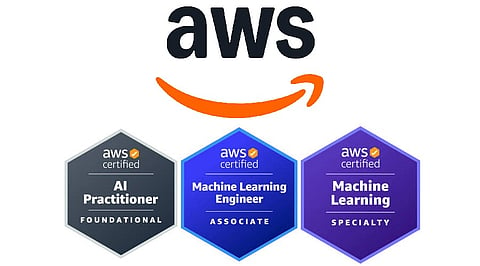
AWS has modernized its certification ecosystem by replacing the legacy Machine Learning – Specialty path with role-specific credentials aligned with today's AI and generative AI workloads.
AWS certifications used to funnel almost everyone toward one exam. This has changed, and the lineup now spans across four credentials, each built for a distinct kind of work. It includes a foundational exam for newcomers, an associate-level path for engineers who build and deploy models, a data-focused associate track, and a professional certification for developers shipping generative AI features.
The Machine Learning Specialty exam was retired for new candidates on March 31, 2026. Existing holders will keep the certification until its original expiry. More than an administrative change, this shift signals AWS's move toward role-based certifications that better match candidates' actual job responsibilities.
The active AWS AI and ML certifications include:
AWS Certified AI Practitioner (Foundational): It covers core AI and machine learning concepts, responsible AI practices, and how AWS services support common use cases. No coding background is required.
AWS Certified Machine Learning Engineer – Associate: This exam focuses on building, tuning, deploying, and monitoring machine learning models using services such as Amazon SageMaker, Amazon S3, and Amazon CloudWatch. Built for professionals who already have hands-on ML experience.
AWS Certified Generative AI Developer – Professional: It validates the ability to integrate large language models into applications, build retrieval-augmented generation (RAG) architectures, and work with vector databases and Amazon Bedrock for production-ready AI solutions.
AWS Certified Data Engineer – Associate: The certification centers on designing and managing data pipelines, storage, and reliable data infrastructure that supports machine learning and generative AI workloads.
A newcomer pivoting into AI from another field or a business analyst who needs to speak the same language as an engineering team gets the most value from AI Practitioner. It builds a baseline in AI and ML concepts without demanding coding depth.
Someone already training and deploying models is better served by ML Engineer – Associate, which centers on data preparation, model tuning, and running workloads in production rather than staying inside a notebook.
Developers already working with large language models, RAG pipelines, and Bedrock fit the Generative AI Developer – Professional role. This credential expects prior implementation experience rather than theory alone, and choosing it over AI Practitioner or ML Engineer comes down to one question: is the work built around foundation models or traditional ML pipelines?
Data engineers who feed pipelines into ML systems should look at Data Engineer – Associate, a track that rarely gets the same attention as the AI-branded exams but supports all of them underneath.
Product managers and stakeholders overseeing AI projects without building them get more practical value from AI Practitioner than from an engineering-level exam, since the goal is informed oversight rather than hands-on implementation.
The simplest approach starts with hands-on experience, not ambition. Someone new to AWS and AI belongs in AI Practitioner first. Someone already building or deploying models can skip straight to ML Engineer – Associate. A developer working with foundation models in production is the right candidate for Generative AI Developer – Professional.
A common progression looks like AI Practitioner, then ML Engineer – Associate or Data Engineer – Associate depending on the role, then Generative AI Developer – Professional once foundation model work becomes part of the job.
For those already deep into machine learning specialty prep, finishing it still holds some value, given less than a year remains before it closes to new candidates. For everyone else, moving straight to ML Engineer Associate offers more current coverage and a clearer path forward.
The strongest certification choice rarely lines up with the most advanced option available. It lines up with what the job actually requires now and with where that job is headed next.
Also Read: Top 10 Data Science Concepts You Must Learn in 2026
AWS restructuring its AI credentials around roles rather than a single tiered ladder points to where cloud certification is heading in general. It clarifies that the exam is less about climbing a fixed hierarchy and more about proving specific, current skills tied to specific work. Candidates who treat certification as a career-mapping exercise, rather than a checklist, will likely find their credentials relevant as AWS splits its portfolio.
The AWS Certified AI Practitioner is the best starting point for beginners. It covers foundational AI, machine learning, and AWS concepts without requiring advanced technical experience.
The AI Practitioner certification focuses on AI fundamentals, while the Machine Learning Engineer – Associate is designed for professionals who build, deploy, and manage machine learning solutions on AWS.
The AWS Certified Generative AI Developer – Professional is the most relevant certification for developers working with foundation models, Amazon Bedrock, retrieval-augmented generation (RAG), and AI-powered applications.
AWS is retiring the Machine Learning – Specialty certification. Professionals looking to validate AI and ML skills should consider newer certifications such as AI Practitioner, Machine Learning Engineer – Associate, and Generative AI Developer – Professional.
Choose a certification based on your current role and career goals. Beginners can start with AI Practitioner, while ML engineers can pursue Machine Learning Engineer – Associate, and experienced developers building AI applications may benefit most from the Generative AI Developer – Professional certification.
