.png)

Ahmedabad: A restaurant can have a popular menu, steady footfall and a loyal customer base and still struggle to remain profitable. Behind many of the challenges faced by restaurant operators are less visible operational problems, including food wastage, stock leakage, poorly tracked discounts and a limited understanding of what individual dishes actually cost to prepare.
As the restaurant industry becomes increasingly technology-driven, operators are paying greater attention to the numbers behind every order. Sales remain important, but understanding where money is being lost between purchasing ingredients and serving a customer can be equally critical to the health of the business.
“Most restaurants don’t fail because nobody came. They fail because nobody counted.”
The problem often begins with inventory. Restaurants handle large quantities of perishable products every day, making wastage an unavoidable part of the business. However, without accurate tracking, the difference between expected and actual consumption can remain difficult to identify.
For a restaurant owner, a few kilograms of excess ingredients may not appear significant on a single day. Repeated across weeks and across multiple outlets, however, small gaps can accumulate into a meaningful cost.
Stock leakage presents another challenge. Ingredients move through several stages before reaching the customer, from procurement and storage to preparation and service. Without systems that connect inventory with sales, identifying where the mismatch occurred can become difficult.
Menu pricing can create another blind spot. Restaurant owners often know the selling price of a dish, but understanding its actual cost requires accounting for ingredients, wastage and changes in input prices. When those calculations are not regularly updated, a dish that appears to be a strong seller may not necessarily be a profitable one.
Discounts can add to the complexity. Promotions are often used to attract customers, increase order volumes or compete in a crowded local market. But when discounts are not tracked carefully against actual margins, higher sales can sometimes conceal weaker profitability.
These challenges become more complicated as restaurants expand. A single outlet may be able to operate using spreadsheets, notebooks and the owner's direct supervision. With multiple outlets, however, maintaining visibility across purchases, inventory, sales and wastage becomes considerably harder.
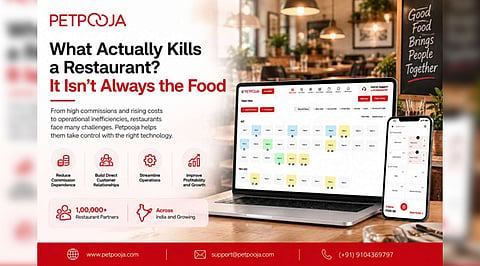
This is one area where restaurant-specific technology is becoming increasingly relevant. Petpooja's POSS platform, which is used by more than 1,00,000 restaurants, brings together billing, inventory, menu management, kitchen operations, aggregator orders, CRM and reporting.
The significance of such systems lies less in the billing transaction itself and more in the information generated around it. When sales and operational data are connected, restaurant operators can examine which products are selling, how inventory is moving and where discrepancies may require attention.
The availability of more than 100 reports through POSS is designed to give operators greater visibility into these areas. For a small restaurant, the benefit can be as straightforward as identifying a consistently wasted ingredient. For a growing chain, it can involve comparing operational performance across outlets and identifying differences that would otherwise remain hidden.
Technology, however, does not eliminate the underlying operational challenges. Restaurant owners still need to make decisions about purchasing, portion sizes, menus, pricing and staffing. What digital systems can change is the visibility available when those decisions are made.
That visibility is becoming increasingly important as restaurants deal with fluctuating input costs, changing customer preferences and competition across dine-in, takeaway and delivery channels.
The industry's focus on digitalisation has often centred on customer-facing technology such as online ordering, delivery platforms and digital payments. But the next layer of digitisation is taking place behind the counter, where better information can influence the economics of running a kitchen.
For restaurant operators, the lesson is increasingly straightforward. A busy restaurant is not necessarily a profitable restaurant. Revenue can indicate how much business is coming through the door, but profitability depends on what happens to that revenue after ingredients, wastage, discounts and other operating costs are accounted for.
As more restaurants adopt connected technology, the ability to see those numbers in one place could become an increasingly important part of managing the business. In an industry where margins can be affected by dozens of small operational decisions every day, knowing what is happening behind the numbers may be just as important as knowing how many customers walked through the door.
