.png)

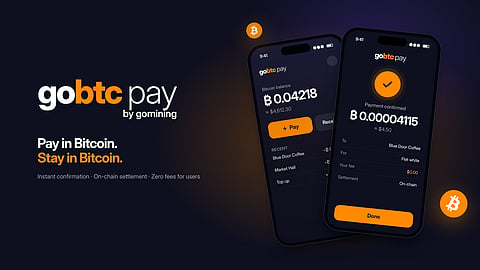
GoBTC Pay gives Bitcoin the checkout experience of a bank card: the payment is approved the moment the buyer signs, and final settlement happens on the Bitcoin base layer afterwards. Buyers pay no direct fee, merchants pay 0.2%, and every payment settles in native BTC, not a wrapped token or sidechain asset.
Its real significance is architectural. GoBTC Pay is a protocol with a wallet SDK, so any Bitcoin wallet, POS system or ecommerce checkout can add instant payments without building a payments stack or asking users to manage Lightning channels.
Instant approval at checkout, with no wait for block confirmations
$0 direct fee for buyers; 0.2% for merchants, well below typical card rates
Native BTC settled on Layer 1, with every payment recorded on-chain
2-of-3 multisig: GoMining cannot move user funds on its own
Settlement backed by GoMining's private mining pool (about 15 EH/s)
Built to be embedded: wallet SDK, with POS and ecommerce integrations on the roadmap
Planned fiat payout for merchants who do not want to hold BTC
Approval is instant; final on-chain settlement follows later (target: about 12 hours by end of 2026)
Merchants rely on GoMining for reconciliation and payout
The recovery custodian is an additional party in the trust model
Wallet and merchant integrations are still ramping up
Bitcoin is a strong store of value but an awkward way to pay for a coffee. A base-layer transaction takes around 10 minutes to confirm, sometimes longer, and fees rise when the network is busy. No buyer wants to wait at the counter, and no merchant wants to release goods against an unconfirmed payment.
The existing workarounds each ask for a compromise. Lightning is fast but brings channels, liquidity and routing into the picture. Custodial processors are simple but take control of the funds and often settle in internal IOUs. Wrapped and sidechain BTC move quickly but are not Bitcoin itself.
GoBTC Pay takes a different route: it separates the moment of payment from the moment of settlement, the same way card networks have always worked, while keeping native BTC and Layer 1 settlement underneath.
A GoBTC Pay payment moves through four steps:
The buyer funds a dedicated spending balance, a 2-of-3 multisig wallet, from their regular Bitcoin wallet.
At checkout, the buyer scans the merchant's GoBTC QR code and signs a Bitcoin payment authorization.
GoMining verifies the signed authorization and returns an "Approved" response to the merchant within seconds.
GoMining batches pending payments, boosts fees where needed, and routes the batch through its own mining pool for confirmation on Bitcoin L1.
The multisig design is what keeps this from being a custodial wallet. Keys are held by the user, GoMining and an independent recovery custodian, and any two are required to move funds. GoMining cannot spend the balance alone, and every debit still requires the user's signature.
Moving BTC into the spending balance does not hand ownership to GoMining. It works like moving money from savings into an everyday account: users fund it with what they plan to spend and keep the rest in fully self-custodial storage.
On a $100 sale, a merchant pays $0.20 with GoBTC Pay, against roughly $1.50 to $3.50 for a typical US card transaction. The buyer pays nothing directly; GoMining absorbs the on-chain settlement cost and recovers it through the merchant fee.
The model is sustainable because GoMining controls its own settlement path. Batching many payments into fewer transactions, and confirming them through a private pool with about 15 EH/s (roughly 1.5% of global hashrate), keeps per-payment L1 cost low even when public fees spike. Revenue sharing with wallets also aligns the incentive for distribution: wallets earn on every payment their users make.
For a Bitcoin wallet, GoBTC Pay is a payments feature delivered through an SDK. The wallet keeps its users, brand and self-custody model, adds an instant-pay balance, and earns 0.1% on every payment. Integration runs through the SDK and a partnership with GoMining.
For a merchant, GoBTC Pay is designed to behave like any other payment processor. The roadmap covers:
POS terminal
Merchant dashboard
Developer SDK
WooCommerce plugin
Merchants get an instant approval at the till and never have to track confirmations, mempool congestion or individual transactions. GoMining handles approval, batching, reconciliation and payout.
A planned fiat off-ramp means a business can accept BTC at checkout and receive local currency for rent, payroll and suppliers, without touching an exchange. Supported currencies, timing and countries will be confirmed as the merchant service rolls out.
The GoBTC Pay wallet on iOS and Android is a reference front end that shows how the protocol looks inside a wallet. Most users are expected to reach GoBTC Pay through wallets they already use, once integrations go live.
Setup follows the familiar wallet pattern: install, back up the seed phrase, then add a PIN and optional biometrics. The app shows two balances side by side:
Bitcoin wallet: fully self-custodial, for holding
BTC Pay balance: the multisig spending account used for instant payments
Paying takes four taps: open the BTC Pay tab, tap Pay, scan the merchant's GoBTC QR code, and confirm. The scanner accepts only GoBTC payment codes, which limits the risk of paying a spoofed address.
GoBTC Pay sits between Lightning, custodial processors and cards: it matches their checkout speed while keeping native BTC, on-chain records and shared-key custody.
Where cards still lead is acceptance, chargeback protection and familiarity. GoBTC Pay's advantage is a cost an order of magnitude lower and a way for BTC holders to spend Bitcoin itself.
GoBTC Pay reduces the trust a fast Bitcoin payment requires, though it does not remove it entirely. The design is built so that no single party, including GoMining, can move a user's spending balance alone.
Multisig custody: user, GoMining and recovery custodian each hold one key; two are needed to move funds.
User-signed debits: every payment from the spending balance carries the user's signature.
Recovery path: if GoMining were unavailable, the user and the recovery custodian can move funds together.
Scoped exposure: only the spending balance sits in multisig; savings stay in the user's self-custodial wallet.
The remaining trust points are clear. Users rely on the recovery custodian as a backstop, and merchants rely on GoMining to reconcile and pay out on time.
GoBTC Pay is built by GoMining, a Bitcoin mining company that launched its digital mining platform in 2021. GoMining runs its own private mining pool of about 15 EH/s, which is what allows GoBTC Pay to settle payments on Bitcoin L1 at low cost. GoBTC Pay launched publicly in May 2026 as the payments arm of the GoMining ecosystem.
Bitcoin wallets that want to offer payments without building a payments stack
Merchants that want to cut processing costs from card-level rates to 0.2%
Merchants that want BTC acceptance with the option of fiat payout
Bitcoin holders who want to spend BTC day to day without managing Lightning
Users who want sole control of every satoshi at all times; GoMining and a recovery custodian share the spending wallet's keys
Use cases that need final on-chain confirmation at the moment of payment
Merchants that want to run settlement themselves end to end
GoBTC Pay is one of the more credible attempts to make Bitcoin work as everyday money. It pairs card-like checkout speed with native BTC, Layer 1 settlement and shared-key custody, and its fee and revenue-sharing model gives wallets and merchants a concrete reason to adopt it.
The open question is distribution. The protocol is live and the economics work; its impact will depend on how quickly wallets, POS providers and ecommerce platforms integrate it.
Is GoBTC Pay free to use? For buyers, yes. There is no direct transaction fee. Merchants pay 0.2%.
Is it the same as Lightning? No. Lightning uses payment channels and records only channel openings and closings on-chain. GoBTC Pay uses signed authorizations and settles every payment on Bitcoin L1.
Does a payment settle instantly on Bitcoin? Approval is instant. On-chain settlement follows in batches, with a target of about 12 hours by end of 2026.
Who controls the funds? The spending balance is a 2-of-3 multisig shared by the user, GoMining and a recovery custodian. GoMining cannot move funds alone.
How are fees kept low with L1 settlement? Payments are batched and confirmed through GoMining's private mining pool of about 15 EH/s.
Is GoBTC Pay an app or a protocol? A protocol. The GoBTC Pay app is a reference wallet; the SDK lets any Bitcoin wallet offer the same experience.
Join our WhatsApp Channel to get the latest news, exclusives and videos on WhatsApp
_____________
Disclaimer: Analytics Insight does not provide financial advice or guidance on cryptocurrencies and stocks. Also note that the cryptocurrencies mentioned/listed on the website could potentially be risky, i.e. designed to induce you to invest financial resources that may be lost forever and not be recoverable once investments are made. This article is provided for informational purposes and does not constitute investment advice. You are responsible for conducting your own research (DYOR) before making any investments. Read more about the financial risks involved here.
