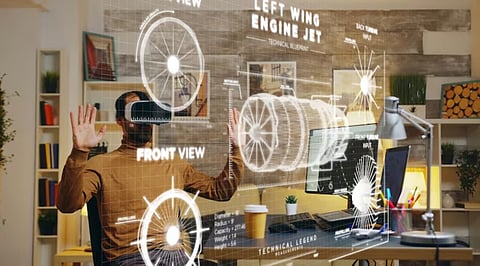
.png)

AI-powered smart glasses could make augmented reality more useful in everyday life.
Spatial computing and enterprise applications are expected to expand AR adoption.
Privacy concerns will grow alongside cameras, microphones, and increasingly intelligent wearable devices.
Augmented reality does not mean only phone-based filters and experimental gadgets like headsets. In 2027, the technology will become wearable, AI- and spatial computing-driven, and more business-focused, with smart glasses as a key driver.
There is evidence that this trend will materialize in the market. IDC forecasts a 167% year-over-year increase in smart glass shipments globally in Q1 2026, to 2.25 million units.
Practical, immersive, and everyday use cases will dominate the technology's future development. The following are key trends to watch in 2027.
The most significant change in the field will be the combination of AI assistants with smart glasses. It means that smart glasses will recognize not just digital objects but also what a user sees, hears, and asks.
Google is already positioning Android XR glasses around Gemini, with features including directions, messaging, and photography, all without requiring users to take out their phones.
IDC says global smart-glasses shipments jumped 167% year over year in Q1 2026, signaling strong momentum heading into 2027.
The trend extends beyond AR alone. Display-less smart glasses are already driving much of the current growth, with companies focusing on AI-first, always-on eyewear experiences.
Consumers increasingly want AR experiences without wearing heavy headsets. Omdia expects XR growth to return in 2027, driven primarily by lighter XR glasses while traditional headset shipments continue to struggle.
Omdia forecasts global XR headwear shipments to reach 6.5 million units in 2027, up 4.8% from 6.2 million units in 2026. The recovery is expected to be driven by the expansion of XR glasses.
By 2027, expect greater emphasis on normal-looking frames, longer battery life, better displays, and wireless connectivity.
AR will increasingly understand the physical environment around users. Spatial computing will allow digital information, virtual screens and 3D objects to remain anchored to real-world spaces.
This could make AR useful for work, navigation, education, design, retail and entertainment, rather than treating it merely as a visual novelty.
The industry is increasingly linking spatial computing with AI, creating systems that can understand where users are, what they are looking at, and what they are trying to do.
Businesses are likely to remain among AR's strongest customers. Manufacturing, healthcare, energy, and utilities are already major drivers of enterprise AR adoption.
Applications will include remote assistance, worker training, maintenance, surgical support, and digital-twin visualization.
The enterprise opportunity is also moving toward AI agents that can use video, audio, and sensor data to understand environments, retrieve information, and assist workers in real time.
Generative AI could dramatically reduce the time and technical expertise needed to build AR experiences. Developers will create 3D objects, scenes, animation, and interactive AR content using natural language prompts.
This will reduce the costs of creating AR content and increase the number of developers.
Generative AI and spatial computing will also make AR experiences more contextual rather than overlaying the real world with digital information.
Navigation using AR can be a big everyday use case. Users will not need to keep looking down at their phones. Instead, they would see directional pointers, landmarks, transportation details, and even recommendations right through their glasses.
Google's Android XR strategy already points toward hands-free directions and contextual assistance.
This is an important change in how AR could fit into everyday life: the technology becomes useful without demanding a user's full attention.
Also Read: Is Augmented Reality the Future of Manufacturing?
Live translation is another strong candidate for mainstream AR. Translation may be achieved with smart glasses that integrate microphones, cameras, AI, and a display.
Such capabilities may prove to be quite useful during international travel, business meetings, and learning processes.
As smart glasses grow more powerful, translation services may be among the AI-powered features offered through eyewear.
AR will be used more frequently by retailers to enable customers to visualize products before making a purchase. This can benefit many sectors, including furniture, fashion, automotive, cosmetics, and consumer electronics.
After this, the next logical step would be context-aware AR powered by AI.
Gaming technology will increasingly become more physical, with AR gaming incorporating real-life places, objects, and people into gameplay.
Instead of adding virtual characters on top of what a person sees through a camera, future gaming will involve making streets and even homes become part of a game.
Always-on cameras and microphones create an obvious privacy challenge. As AR glasses become more capable, governments, businesses and consumers will have to establish clearer rules around recording, facial recognition, data collection and consent.
This problem will become increasingly clear as smart glasses become more widespread. According to IDC, the number of shipped smart glasses grew by 167 percent year-over-year in the first quarter of 2026, while stories of abuse through secret recordings have raised awareness about privacy concerns.
The debate will gain importance as the adoption of AR glasses increases.
Also Read: Top High Paying Careers in Virtual Reality and Augmented Reality in 2026
The defining AR trend of 2027 may not be a single breakthrough device. Instead, it will be the convergence of AI, smart glasses, spatial computing, and real-time contextual information.
The market is already moving in this direction. IDC expects smart glasses to continue displacing traditional VR/MR headsets as the primary growth engine for XR through the forecast period. Optical see-through display glasses are also forecast to grow from 3 million units in 2026 to 12.2 million by 2030, representing a 41.9% CAGR.
Omdia, meanwhile, expects the XR market to return to growth in 2027 as lighter glasses increasingly replace bulkier headsets. In short, 2027 could be the year AR begins shifting from something we deliberately ‘use’ to something that quietly works around us.
What are the biggest augmented reality trends for 2027?
AI-powered smart glasses, spatial computing, enterprise applications, real-time translation, immersive shopping, gaming, and privacy are expected to dominate AR.
Will smart glasses become mainstream in 2027?
Lightweight, AI-powered smart glasses could become mainstream as manufacturers improve displays, battery life, connectivity, and everyday usability.
How will AI impact augmented reality?
AI will help AR devices understand surroundings, answer questions, generate content, provide translations, and deliver more personalized contextual experiences.
Which industries will benefit most from AR?
Manufacturing, healthcare, energy, retail, education and entertainment could benefit significantly from AR-powered training, assistance, visualization and immersive experiences.
Why will privacy become important for AR?
Always-on cameras and microphones raise concerns around recording, facial recognition, data collection, and consent as AR glasses become increasingly common.
