.png)

The fanless module uses a space radiator to handle heat on a Moon with no air.
Planned tests cover language models, image analysis, LiDAR mapping, and the first supercomputer-class benchmarks on the Moon.
Launch, landing, and the 10-day run all remain plans until the mission delivers results.
Every computer that Hewlett Packard Enterprise (HPE) has sent to space so far worked 254 miles above Earth, in low Earth orbit. The Moon offers no air, harsher radiation, and a longer wait for help from the ground. HPE now plans to find out whether a machine ready for artificial intelligence (AI) work can survive there, and the result could shape how future rovers and crewed bases make their own calls.
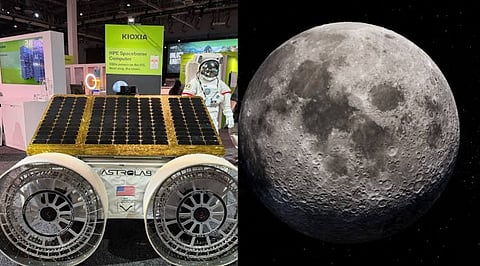
The machine is Spaceborne Computer-4, which HPE announced on October 20, 2026. Its predecessor, Spaceborne Computer-2, reached the International Space Station (ISS) in 2021 and ran AI work in orbit without sending data to Earth first. The new unit rides on FLIP, short for Flex Lunar Innovation Platform, a rover from the California company Astrolab.
Heat comes first. A fan needs air to carry warmth off a chip, and the Moon has none. HPE dropped the fans and gave the module a space radiator and a lightweight aluminum body with a lattice pattern that conducts heat.
The module packs a low-power 64-bit central processing unit (CPU) and a graphics processing unit (GPU). It draws power from the rover’s batteries and solar cells and ties into FLIP’s thermal system. Storage comes from Kioxia solid-state drives (SSDs).
Kioxia has flown its standard flash drives in space for years, so HPE already holds data on how commercial storage holds up. A small consumer-grade drive that feeds GPU-based AI inference on the Moon would show that costly custom parts are not always required.
SpaceX’s Falcon Heavy rocket will launch the payload in late 2026, and one outlet cites November as the target. Griffin, a lander from Astrobotic (now part of Voyager Technologies), will carry FLIP to the Moon’s south pole. NASA runs the flight under its Commercial Lunar Payload Services (CLPS) program and named it Moon Base II in May 2026. The touchdown date remains unannounced.
The lander went through nearly three months of environmental trials at NASA’s Jet Propulsion Laboratory (JPL) in late September, with thermal-vacuum, acoustic, and vibration checks. FLIP measures roughly 7 feet (2.13 m) long and weighs about 500 kilograms. This makes it the largest American rover headed to the Moon since the Apollo buggies, by The Register’s count.
Astrolab designed it to last about a year and to outlast lunar nights that run close to 14 Earth days. The computer’s own plan is shorter: a 10-day surface run, and HPE expects the module to work for all of it.
Also Read - How SpaceX Changed Rocket Technology
HPE lists several jobs for the module. It will run retrieval-augmented generation with a large language model (LLM), image analysis, and scans from LiDAR, a laser-based distance sensor, for navigation maps. An AI services container will check whether scalable apps deploy reliably at the lunar edge, and HPE expects the first supercomputer-class benchmarks on the Moon.
NASA adds its own work. JPL supplies a localization software experiment, and the FLUID experiment will test how three AI models coordinate, with a neural network trained on Earth, Moon, and ISS data. Astrolab founder and CEO Jaret Matthews pitches the payload as the ‘first AI experiments on the moon.’ Back in Hawthorne, California, HPE Private Cloud and CloudOps Software will manage and automate workloads from Astrolab’s mission control.
Signals from Earth arrive late, and each command that waits on a human adds delay. A rover that reads its own images and maps can choose a path or flag a hazard at once. The experiments test whether language models can make useful decisions when help runs late and the hardware sits in lunar conditions. The wheels on FLIP, from Venturi, also suit a NASA rover slated to launch in 2028, so the flight proves out more than one supplier’s gear.
Why this Matters
Moon missions face signal delays and harsh conditions that make Earth-based control slow. Spaceborne Computer-4 tests whether AI can think and act on the lunar surface itself. A win would cut costs through commercial parts, speed up rover decisions, and prepare crewed bases to run with less ground support.
Also Read - AI Boom Leaves Aerospace Short of Engineers
Launch dates have slipped before, and a failed touchdown would end the run no matter how well the machine works. The 10-day window also covers a small slice of FLIP’s year-long design life, so the first lunar night stays untested for the computer.
If the module works, the question shifts from whether commercial parts can survive on the Moon to how much decision power crews and mission teams hand to onboard AI. That shift would matter more than any single benchmark score.
1.What is Spaceborne Computer-4?
It is HPE’s compact AI computer built for the lunar surface. The module holds a low-power 64-bit CPU and a GPU, with Kioxia solid-state drives for storage.
2.Where will it go?
Astrolab’s FLIP rover carries it to the Moon’s south pole on Astrobotic’s Griffin lander. SpaceX’s Falcon Heavy will launch the lander under NASA’s Commercial Lunar Payload Services program.
3.When will it launch?
HPE and NASA both place the launch in late 2026, and one outlet cites November. The landing date has not been announced.
4.What will it test?
The module will run large language model retrieval, image analysis, and LiDAR mapping. NASA’s Jet Propulsion Laboratory adds a localization experiment, and the FLUID experiment tests how three AI models work together.
5.How long will it run?
The plan calls for a 10-day surface run. FLIP itself is built to last about a year.
