.png)

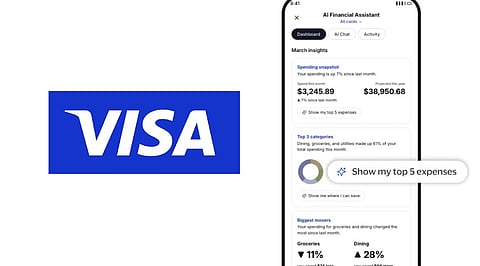
Visa introduced a white-label AI assistant that banks can place inside their own apps. It offers spending summaries, plain-language answers, and in-chat actions such as locking a card.
The main shift is the link between insight and action, which sets it apart from many bank chatbots.
A US pilot was set for August 2026. Governance, accuracy, and the limits on advice will decide how far it goes.
Visa says more than 66% of surveyed Americans who have used generative AI turn to it for financial advice. The company wants banks to answer that demand inside their own apps. Its Visa AI Assistant, formerly named AI Financial Assistant, pairs a chat window with real account tools. The idea matters less for the conversation than for what follows it. A customer can ask a question, then act on the answer without leaving the app.
Visa announced the service on July 14, 2026. It said US financial institutions would get a pilot in August 2026, with a global rollout planned afterwards. Outside tools already compete for the same questions.
OpenAI says 200 million people use ChatGPT for financial advice. Its service links bank accounts through Plaid. Commonwealth Bank of Australia began testing its own AI companion in May.
Visa argues that banks hold an edge in trust. It says consumers see banks as the most trusted institutions for protecting personal data. It also says 85% would share more data with their bank if the AI offered clear value. These figures come from Visa.
The survey details were not visible in the coverage reviewed. That trust gives banks a starting point. Services such as ChatGPT first ask customers to connect their accounts.
Visa sells the tool to banks, not shoppers. Banks can offer it under their own brand with no custom development. They can also connect their FAQs and documents. Customers could then ask about products such as car loans or savings accounts. It runs inside the issuer's app. Customers do not need to link accounts to an outside service. The table lists the capabilities named in coverage.
Many bank chatbots answer basic questions or point users to help pages. This assistant joins understanding with action. A customer could ask why spending rose in October. The answer would come from that cardholder's own activity. A card tied to an odd charge could then be locked on the spot.
Card locking is a low-risk step that customers can usually undo. That makes it a controlled place to start. Harder actions will test the design far more.
The build also deserves attention. Banks can already deploy single features through Visa's Digital Enablement SDK. The assistant works as a central layer that links those features as they arrive. The chat window is the visible part. The connecting layer is the deeper product.
Data inputs need care. One report lists cardholder activity, real-time information, and bank data. Another says the assistant connects to Visa's transaction data and the bank's own information. The coverage reviewed does not explain how network-level data is used.
Javelin Strategy & Research analyst Christopher Miller says the tool targets a bank problem more than a customer problem. Banks need a way to offer AI assistant services. Visa executive Michele Herron frames the goal as moving banks from passive ledgers to AI-enabled financial hubs.
The strategic stake is the customer interface. A bank that hands the money conversation to an outside app becomes a background service. That risk gives banks a reason to embed tools like this one. For Visa, the product extends its role beyond payment processing into digital engagement.
Governance will decide the outcome. Banks must set clear lines between general insights, regulated advice, and automated account actions. A note that a customer spent more on dining is an observation. A suggestion to cut the dining budget is a recommendation. Banks must also decide when a chat should pass to a human adviser.
Visa says the service follows its AI and data governance standards. The coverage reviewed includes no independent testing. Accuracy matters most when answers involve transactions.
Visa plans to link spending insights with subscription management through its Enhanced Subscription Manager. That would extend the assistant from explaining recurring charges to managing them. As of early October 2026, the coverage reviewed the names of no pilot institutions and shares no results.
The Visa AI Assistant starts with controlled tasks. It summarizes spending, answers questions, locks cards, and sets alerts. Its value lies in joining financial context with action inside an app that customers already use. Pilot results will show whether that pairing holds up at scale.
The next signal will come from usage. If customers return to the chat after the first month, banks will have reason to widen what they can do. If they do not, it will stay a novelty. Pilot data, once shared, should show which path the feature takes.
1. What is Visa's AI Financial Assistant?
It is a chat-based service that banks can add to their own mobile apps. Cardholders can review spending, ask questions about their finances, and take some actions in the same conversation. Visa sells it to financial institutions, which offer it under their own brand.
2. What can it do at the start?
The first version sends monthly spending insights and answers questions in plain language based on a cardholder's own activity. Customers can also lock a card or set alerts from the chat. Visa plans to add subscription management through its Enhanced Subscription Manager.
3. Is it available to customers now?
Not broadly. Visa said US financial institutions would get a pilot in August 2026, with a global rollout to follow. Coverage reviewed in early October 2026 names no pilot banks and shares no results. Availability depends on whether a customer's bank adopts it.
4. How is it different from a typical bank chatbot?
Many bank chatbots answer basic questions or point users to help pages. This assistant links answers to actions, such as locking a card. It also runs inside the bank's own app, so customers do not need to connect their accounts to an outside service.
5. What are the main risks?
Accuracy is the first concern, since a wrong answer about a transaction can have financial effects. Banks must also set clear limits between general insights, regulated advice, and account actions. Visa says the service follows its AI and data governance standards. The coverage reviewed includes no independent testing.
