.png)

The Olam Labs co-founder is exploring how interactive environments can generate the behavioral feedback and training data needed for AI systems that must operate over time alongside people and other agents.
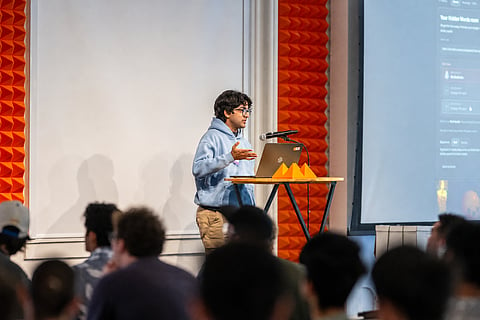
An interaction between intelligent participants can produce something a static example cannot: decisions that provoke responses and change what happens next. Om Buddhdev is building AI environments around that premise. As co-founder and CEO of Olam Labs, he develops multi-agent and human-agent simulations designed not only to evaluate models, but also to generate behavioral signals that can inform post-training. His work focuses on what AI systems can learn when they must respond to other actors rather than simply complete an isolated task.
“Interactive environments can create training signals that are difficult to get from static examples,” Buddhdev says. “The model makes a decision, another participant responds, and that response changes what happens next. The sequence itself becomes useful information.”
The need for that kind of training is growing as AI systems take on longer and more independent tasks. Models are increasingly expected to use tools, remember context, pursue goals across multiple steps, and operate around people or other agents. Those capabilities create challenges for post-training because useful behavior may depend on circumstances that evolve during an interaction. Buddhdev sees interactive environments as a way to expose models to those conditions while giving researchers material that can be used to improve subsequent performance.
At Olam Labs, Buddhdev and his team build controlled but emergent environments in which communications, actions, incentives, uncertainty, and outcomes develop through interaction. Different strategies can emerge as participants respond to one another, giving researchers access to behavioral data that static examples do not naturally produce. The resulting interactions can show how models negotiate, collaborate, compete, adapt, and continue pursuing objectives as the situation changes. For Buddhdev, that makes simulation useful not only for testing performance, but also for developing the information needed to train more capable agents.
“The useful part is that the model is not operating against a frozen problem,” Buddhdev says. “Other participants are making choices too, so the system has to respond to new information and changing conditions. That gives you a richer set of behaviors to learn from.”
Longer simulations can add another dimension to that data. Some useful behaviors only become relevant after several rounds of interaction, particularly when a model needs to adjust a strategy, maintain cooperation, or recover after an earlier choice produces an undesirable result. Those sequences can provide examples of judgment and adaptation that are difficult to represent through independent prompts and responses. Instead of treating every training example as a separate event, the environment allows behavior to develop across a continuing situation.
Buddhdev is particularly interested in how those interactions could support training for social and agentic capabilities. Negotiation depends partly on what another participant does after receiving an offer or proposal. Collaboration may require a system to adjust as information changes or responsibilities shift. Interactive environments create opportunities to generate data from those exchanges, allowing models to encounter conditions in which successful behavior depends on responding appropriately to someone else.
That idea also shapes Olam Labs’ plans for expanding its datasets. Buddhdev intends to grow the public arena, run larger simulations, deepen behavioral evaluations, and create datasets from top humans and agents. The company also plans to work with frontier AI labs on pre-deployment testing and training. Those efforts are intended to move the environments beyond individual experiments and toward infrastructure that can produce useful data for model development at a larger scale.
“We want to create datasets from top humans and agents inside these environments,” Buddhdev says. “That gives us more information about how different participants approach the same kinds of situations over time.”
Including both human and AI participants can broaden the range of behavior available for training and analysis. Different participants may approach the same problem with different assumptions, strategies, or responses to uncertainty. Buddhdev is interested in using those interactions to develop datasets that reflect more than one path through a problem. The aim is not to assume that every successful behavior should look identical, but to capture enough variety to support better model training.
Unsuccessful interactions can be useful as well. A failed negotiation or poor collaborative choice can expose behavior that training should address, while a later correction can show how a system responds after something goes wrong. That gives post-training access to more than polished examples of successful performance. It can also incorporate situations where judgment improves during the course of an interaction.
“Training data can include the mistakes as well as the successes,” Buddhdev says. “If a model makes a bad choice and later finds a way to recover, that sequence can still contain useful information. You are learning from the behavior across the interaction, not just labeling the final result.”
The approach addresses a broader problem in AI development. As systems take on tasks that unfold across longer periods, developers need training methods that account for context, memory, incentives, and responses from other participants. Static datasets remain important, but some forms of judgment only emerge when the environment reacts to what the system does. Buddhdev’s work is focused on creating those reactive settings in a form that can contribute directly to model improvement.
His plans for Olam Labs reflect that emphasis. Larger simulations could create more varied interactions, while datasets involving skilled human and AI participants could provide additional examples for post-training. Work with frontier labs could then connect those environments to pre-deployment training, where models can encounter complex interactions before being used in less controlled settings. Each step is aimed at turning simulation into a practical source of behavioral experience rather than treating it only as a testing exercise.
For Buddhdev, multi-agent environments are valuable because they can produce feedback that depends on interaction. One participant’s decision changes what another participant does, creating new circumstances that the model must then address. As AI systems take on longer and more autonomous work, he is building around the idea that better training may require more than showing models what good answers look like. It may also require giving them environments where their choices shape what happens next.
