.png)

Freight companies are under pressure. Trade keeps growing, but there aren't enough drivers, warehouses want faster turnaround, and fuel costs keep climbing. Old ways of moving goods can't keep up anymore. This is where automated semi-trucks and autonomous semi-trucks come in. They are not a future idea. They are already changing how goods move through ports, yards, and highways.
A few problems are pushing this change forward.
Labor Shortages & Operational Risks: Trucking has a global shortage of skilled drivers. Autonomous semi-trucks help fill that gap and cut down on accidents caused by tired drivers on long shifts.
Decarbonization & Fuel Optimization: A computer can control speed, braking, and acceleration more smoothly than a person. That means less fuel burned and fewer emissions released.
24/7 Continuous Productivity: Autonomous fleets don't need rest breaks. That means fewer delays, quicker deliveries, and better use of every vehicle in a fleet.
Building a truck that can drive itself is harder than building a self-driving car. A loaded semi-truck weighs many tons and takes much longer to stop. So automated semi trucks need extra layers of safety built in.
Here's what makes it possible:
Multi-Modal Sensor Integration: Cameras, radar, and LiDAR combine to give the truck a full view around it, even in rain, fog, or dust.
Edge AI & Real-Time Decision Engines: Small, powerful processors inside the truck read the road and plan the next move in a fraction of a second.
V2X (Vehicle-to-Everything) Communication: Trucks talk to traffic signals, port systems, and other vehicles nearby. This helps them avoid slowdowns and move through busy areas smoothly.
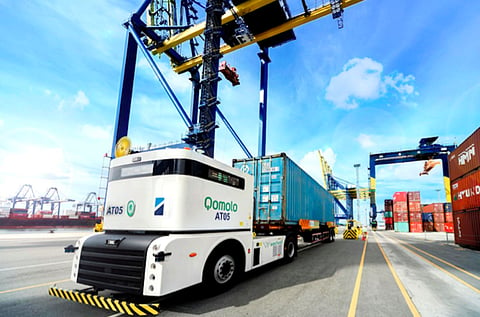
Highways are still catching up on rules and safety checks for driverless trucks. But ports, warehouses, and industrial yards are a different story. These are closed spaces with fixed routes, so it's easier to test and run automated semi-trucks there.
Inside these yards, trucks work next to cranes, forklifts, and workers. Everything has to be timed and coordinated so nothing collides and nothing slows down.
Companies like Westwell are showing what this looks like in practice. Their trucks, fleet software, and charging systems work together as one system, built to fit right into how a port already runs.
The bigger shift isn't just one truck driving itself. It's a whole fleet working as one system.
When autonomous semi-trucks connect to cloud software, they can reroute around traffic jams, plan charging stops ahead of time, and share the workload evenly across a route. Add electric power to this mix, and freight companies get lower running costs along with cleaner operations.
Q1: How do autonomous semi-trucks ensure safety in adverse weather conditions?
They rely on more than one type of sensor at once. Cameras, radar, and LiDAR each pick up what the others might miss, so fog, rain, or dust doesn't block the truck's view of the road.
Q2: What is the main operational difference between port/terminal automation and open-highway trucking?
A port truck focuses on working closely with cranes and yard systems in a fixed space. A highway truck has to handle unpredictable traffic, sudden obstacles, and long stretches of open road at higher speed.
Q3: Are automated semi-trucks fully replacing human drivers immediately?
Not all at once. Ports and closed yards already run fully driverless trucks. On highways, the current setup often mixes autonomous trucks for long stretches with human drivers handling the last few miles.
The move toward automated semi-trucks isn't a question of if anymore. It's a question of how fast. As sensors get cheaper and software gets sharper, more freight companies will have to decide how soon they want to make the switch.
