.png)
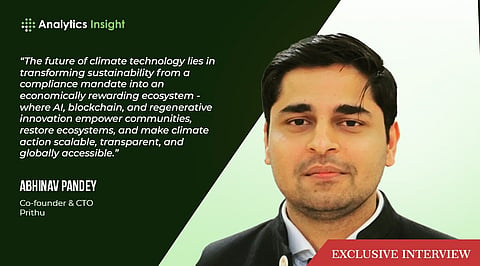
AI, Blockchain, and Digital MRV are Reshaping Climate Markets: Prithu CTO Abhinav Pandey on the Future of Climate Innovation

As climate change accelerates and industries search for scalable decarbonization solutions, technology is becoming critical in transforming how sustainability efforts are measured, verified, and implemented. In this exclusive interview with Analytics Insight, Abhinav Pandey, Co-founder & CTO of Prithu and a featured leader in the ‘Top CTOs to Watch in 2026’ edition of Analytics Insight Magazine, shares insights into building a technology-led carbon removal platform focused on empowering smallholder farmers and enabling measurable climate impact.
With more than 15 years of experience across AI, SaaS, fintech, healthcare, and enterprise technology, he discusses the growing role of AI, satellite intelligence, blockchain, and digital MRV systems in shaping carbon markets, regenerative agriculture, and the future of responsible climate-tech innovation. Here are the excerpts from the interview:
What’s Your Career Journey Been Like, and What are You Working on Currently?
I am the Co-founder & CTO of Prithu, a climate technology company focused on accelerating global decarbonization through regenerative agriculture and technology-driven carbon verification. At Prithu, we are building a full-stack carbon removal platform that enables smallholder farmers to participate in global voluntary carbon markets while generating measurable climate and community impact.
Over the last 15+ years, I have worked across AI, SaaS, consumer technology, enterprise platforms, fintech, healthcare, and emerging technologies. My journey has spanned leadership roles in product engineering, AI platforms, analytics, and large-scale digital transformation initiatives for global enterprises and high-growth startups.
At Prithu, my focus is on leveraging AI, blockchain, satellite technology, and digital MRV (Measurement, Reporting & Verification) systems to create scalable, transparent, and high-integrity carbon ecosystems. Our long-term goal is to sequester 20 million tonnes of CO₂e by 2030 while improving farmer livelihoods and restoring ecological balance.
What Key Experiences or Achievements Have Shaped Your Leadership Approach Over the Years?
A combination of enterprise-scale execution, startup agility, and cross-domain innovation has shaped my leadership philosophy. Leading multidisciplinary teams across AI, SaaS, consumer applications, and enterprise platforms taught me that technology alone does not create impact - execution, empathy, and clarity of purpose do.
One defining experience was building and scaling AI-driven platforms for global enterprises in healthcare, telecom, and fintech. Managing large engineering and product teams across geographies reinforced the importance of empowering people, fostering ownership, and aligning innovation with measurable business outcomes.
Another major influence has been working at the intersection of emerging technologies and real-world challenges. Today at Prithu, we are applying advanced technologies such as AI, blockchain, and satellite intelligence to climate action and regenerative agriculture. This has deepened my belief that the future of leadership lies in creating technology that is not only scalable and profitable but also socially and environmentally transformative.
Let Us Know Some of the Key Challenges You Faced During the Initial Phase of Your Journey in the Technology and Product Development Field.
One of the biggest challenges early in my career was navigating the transition from traditional engineering and industrial systems into the rapidly evolving world of digital products, AI, and SaaS platforms. The technology landscape changes incredibly fast, and staying relevant requires continuous learning and adaptability.
Another challenge was balancing innovation with execution. In product development, it is easy to build technically sophisticated solutions that fail to solve real customer problems. Early on, I learned the importance of deeply understanding user pain points before building products.
Building and scaling teams was another critical learning curve. As organizations grow, maintaining alignment across engineering, product, design, and business teams becomes increasingly complex. I realized that strong communication, clarity of vision, and a culture of accountability are just as important as technical excellence.
In climate tech specifically, one ongoing challenge is establishing trust and transparency in carbon markets. That is precisely why we are investing heavily in digital MRV, blockchain-backed traceability, and AI-powered verification systems at Prithu.
Describe Some of the Vital Attributes That Every Modern Technology and Product Leader Should Possess.
Modern technology leaders must combine technical depth with strategic thinking and human-centric leadership. The first essential attribute is adaptability. Technologies such as AI, LLMs, and automation are evolving rapidly, and leaders must continuously learn and evolve alongside them.
Second, product leaders must remain deeply customer-focused. Successful innovation happens when leaders understand both the explicit and latent needs of users. Technology should simplify lives, solve meaningful problems, and create measurable value.
Third, strong leaders must possess systems thinking. Today’s digital ecosystems are highly interconnected, and leaders need to think across product, data, security, compliance, scalability, and business outcomes simultaneously.
Another critical attribute is ethical responsibility. As AI and automation become more powerful, technology leaders must ensure transparency, fairness, privacy, and sustainability are embedded into product design and organizational culture.
Finally, resilience and execution discipline are vital. Great ideas are abundant, but the ability to consistently execute under uncertainty is what differentiates impactful leaders from visionary thinkers alone.
How do You Innovate Your Products or Solutions to Ensure They Appeal to Your Target Audience and Address Evolving User Needs?
At Prithu, we innovate by combining deep domain understanding with technology-led execution. We start by engaging closely with stakeholders across the ecosystem - farmers, carbon buyers, sustainability partners, and policymakers to understand real-world pain points and adoption barriers.
Our innovation philosophy is grounded in three principles: usability, scalability, and trust. For example, while carbon markets are often perceived as complex and opaque, we use AI-powered digital MRV systems, satellite intelligence, and blockchain-backed traceability to make carbon verification more transparent, efficient, and accessible.
We also believe strongly in iterative product development. Instead of building products in isolation, we continuously test assumptions, gather feedback, and refine solutions based on actual field outcomes and user behavior.
Another key differentiator is our focus on impact-driven innovation. Beyond generating carbon credits, our platform is designed to improve farmer income, promote regenerative agriculture, and create measurable environmental benefits. This alignment between economic incentives and climate outcomes is critical for long-term adoption and scalability.
Artificial Intelligence, Generative AI, NLP, LLMs, Blockchain, And Web3 Are Rapidly Transforming Industries Worldwide. In Your View, Which of These Technologies Will Create the Most Significant Long-Term Impact on Businesses Over the Next Decade, and Why?
I believe AI and Generative AI will create the most profound long-term impact across industries over the next decade. Unlike previous technology waves, AI is not limited to a single domain - it is fundamentally reshaping how businesses operate, innovate, and make decisions.
Generative AI and LLMs are already transforming software development, customer engagement, knowledge management, automation, healthcare, education, and enterprise productivity. The real breakthrough lies in their ability to augment human intelligence at scale.
That said, I also believe the biggest opportunities will emerge when AI converges with other technologies such as blockchain, IoT, and satellite systems. At Prithu, for example, we combine AI-driven analytics with blockchain-backed transparency and satellite-based monitoring to build trusted climate solutions.
Blockchain and Web3 will continue to play an important role in areas requiring traceability, decentralized trust, and digital asset ecosystems. However, AI will likely become the foundational layer powering decision intelligence across every sector.
The organizations that succeed will be those that use AI responsibly to amplify human capability rather than automate processes.
What is Your Advice for Budding or Emerging Technology Leaders, Product Managers, and Tech Executives?
My advice is simple: focus on solving meaningful problems rather than chasing trends. Technology evolves rapidly, but the core purpose of innovation remains constant -creating value for people and society.
Young leaders should invest equally in technical capability, business understanding, and communication skills. The most effective technology leaders are those who can seamlessly bridge engineering, product, operations, and strategy.
I also encourage emerging professionals to develop a strong learning mindset. AI, cloud computing, cybersecurity, and automation are continuously evolving, and adaptability will be one of the most valuable leadership traits in the coming decade.
Another important lesson is to embrace uncertainty and take calculated risks. Many breakthrough innovations emerge from experimentation, iteration, and failure.
Finally, lead with purpose and integrity. The next generation of technology leaders will be measured not only by business growth but also by the societal and environmental impact they create. Building responsible, inclusive, and sustainable technology will define true leadership in the future.
What Role do Data, AI, And Automation Play in Shaping the Future of SaaS and Digital Platforms?
Data, AI, and automation are becoming the foundational pillars of next-generation SaaS and digital ecosystems. Modern platforms are no longer just transactional systems; they are evolving into intelligent, adaptive, and predictive decision-making engines.
AI enables platforms to personalize experiences, automate workflows, improve operational efficiency, and generate actionable insights in real time. Automation reduces manual overhead while enabling organizations to scale faster with greater consistency and reliability.
Data is equally critical because AI systems are only as effective as the quality and integrity of the data powering them. Organizations that can build robust data ecosystems and derive contextual intelligence from them will gain a significant competitive advantage.
In climate tech, these capabilities are especially transformative. At Prithu, we use AI-driven analytics, satellite data, and digital MRV systems to automate carbon measurement and verification processes that were previously manual, expensive, and fragmented.
The future of SaaS will increasingly shift toward autonomous, AI-native platforms capable of proactive decision-making, real-time optimization, and deeply personalized user experiences.
You Have Worked Across Both Enterprise and Consumer Tech Domains. How Do You Ensure Products Remain User-Centric While Scaling Rapidly?
The key to maintaining user-centricity during rapid scaling is staying relentlessly connected to customer outcomes. Whether in enterprise SaaS or consumer technology, product decisions should always begin with understanding user behavior, friction points, and evolving expectations.
One approach I strongly advocate is data-informed product development. Quantitative analytics provide valuable insights into usage patterns, but they must be complemented with qualitative feedback from real users. This balance helps teams avoid building features that are technically impressive but commercially irrelevant.
Another critical factor is a modular and scalable architecture. As products scale, complexity increases significantly. Investing early in robust platform engineering, observability, and product governance helps maintain performance and user experience without compromising agility.
Cross-functional collaboration is equally important. Product, engineering, design, customer success, and business teams must remain aligned around a shared vision of customer value.
At Prithu, even as we build sophisticated climate-tech infrastructure, our guiding principle remains simple: technology should empower users, simplify participation, and build trust at scale.
What Final Advice Would You Like to Share with Emerging Technology and Product Leadership Professionals?
The future belongs to leaders who can combine innovation with responsibility. As technology becomes more powerful, the role of leadership is no longer just about building scalable products; it is about shaping systems that positively impact society, businesses, and the planet.
My advice to emerging leaders is to remain curious, stay adaptable, and never stop learning. Build depth in your core domain, but also develop interdisciplinary thinking, as the biggest innovations often occur at the intersection of technologies and industries.
Do not underestimate the importance of empathy and ethics in leadership. Technology decisions increasingly influence human behavior, livelihoods, privacy, and sustainability outcomes. Responsible innovation will become a defining differentiator.
I also encourage young leaders to think globally but act with local relevance. The most impactful solutions are often those that solve deeply rooted grassroots problems at scale.
Most importantly, build with purpose. Sustainable success comes not only from financial growth but from creating meaningful and lasting impact for people and the world around us.
